
Shop Floor Control - Accounting
| Lines of Code | 1193 |
| Technical name | viin_mrp_workorder_account |
| License | OPL-1 |
| Website | https://viindoo.com/apps/modules/19.0/viin_mrp_workorder_account |
| Read description for | v 18.0 |
| Required Apps | Manufacturing (mrp) Invoicing (account) Discuss (mail) Inventory (stock) Employees (hr) |
| Included Dependencies | Advanced MRP Accounting Shop Floor Control Viindoo Manufacturing Viindoo Base Viin Warehouse Web Gantt Viin Warehouse Accounting Viin Warehouse Accounting - Enterprise Presentation |
Shop floor labour in your product cost, priced person by person
For manufacturers that record operator time on the shop floor
Book the labour, work in progress and analytic entries of Shop Floor Control in accounting.
Community Edition, Viindoo Cloud · OPL-1 · English, Vietnamese
Connects Shop Floor Control with Advanced MRP Accounting.
What changes for your team
Labour per work order, at each person's rate
Today: operator time is priced by hand.
→ Each finished order shows its direct labour per work order, each person at their own hourly cost, frozen when the time closes.
Work in progress per work center
Today: work in progress is tracked outside the system.
→ Consumed components sit on the work center's own analytic account until the finished goods are received.
A period-end entry that counts each component once
Today: components posted early are credited from stock twice.
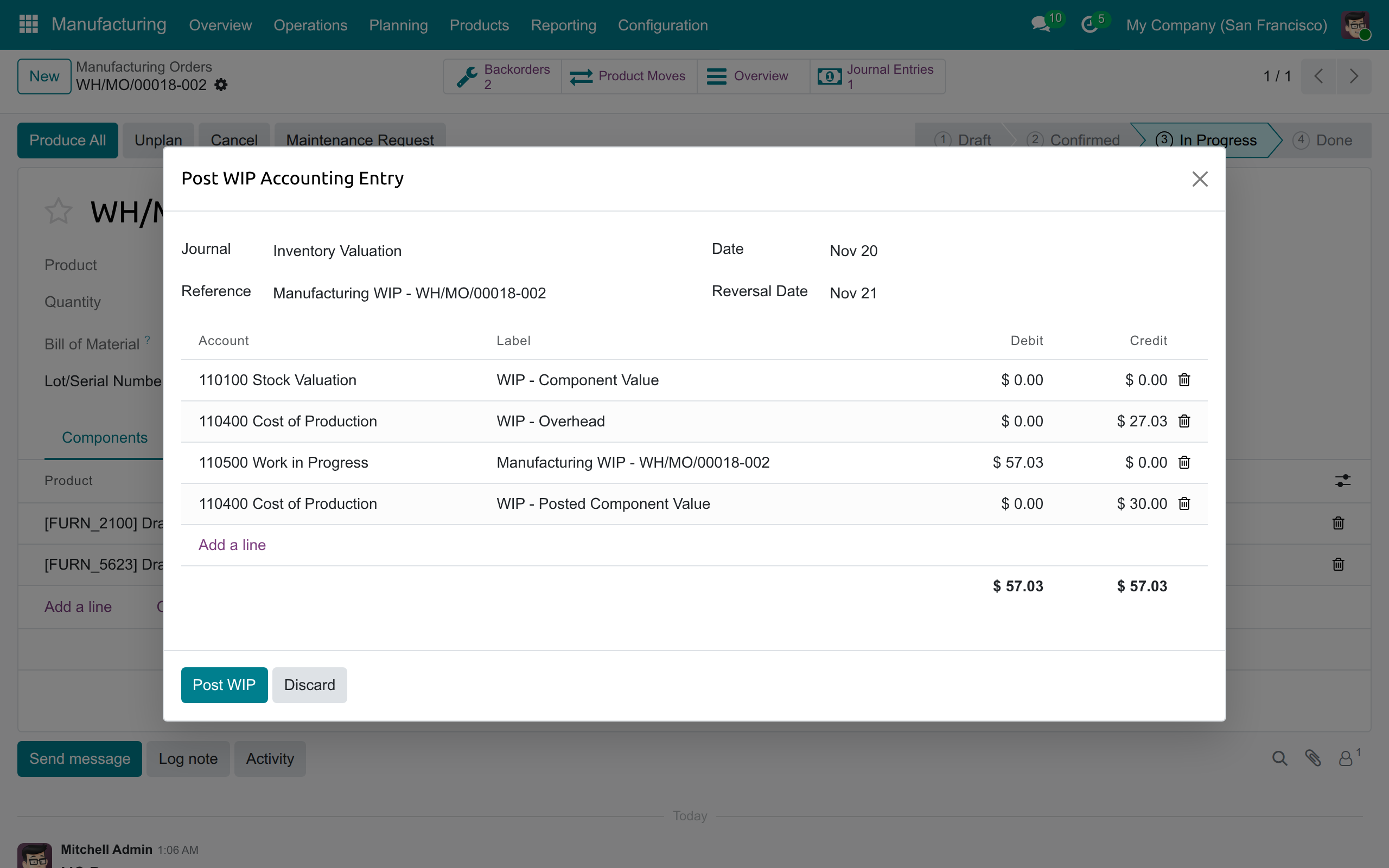
→ The period-end entry leaves out components already posted with Post Consumption and moves their value into work in progress.
What you see as a manager
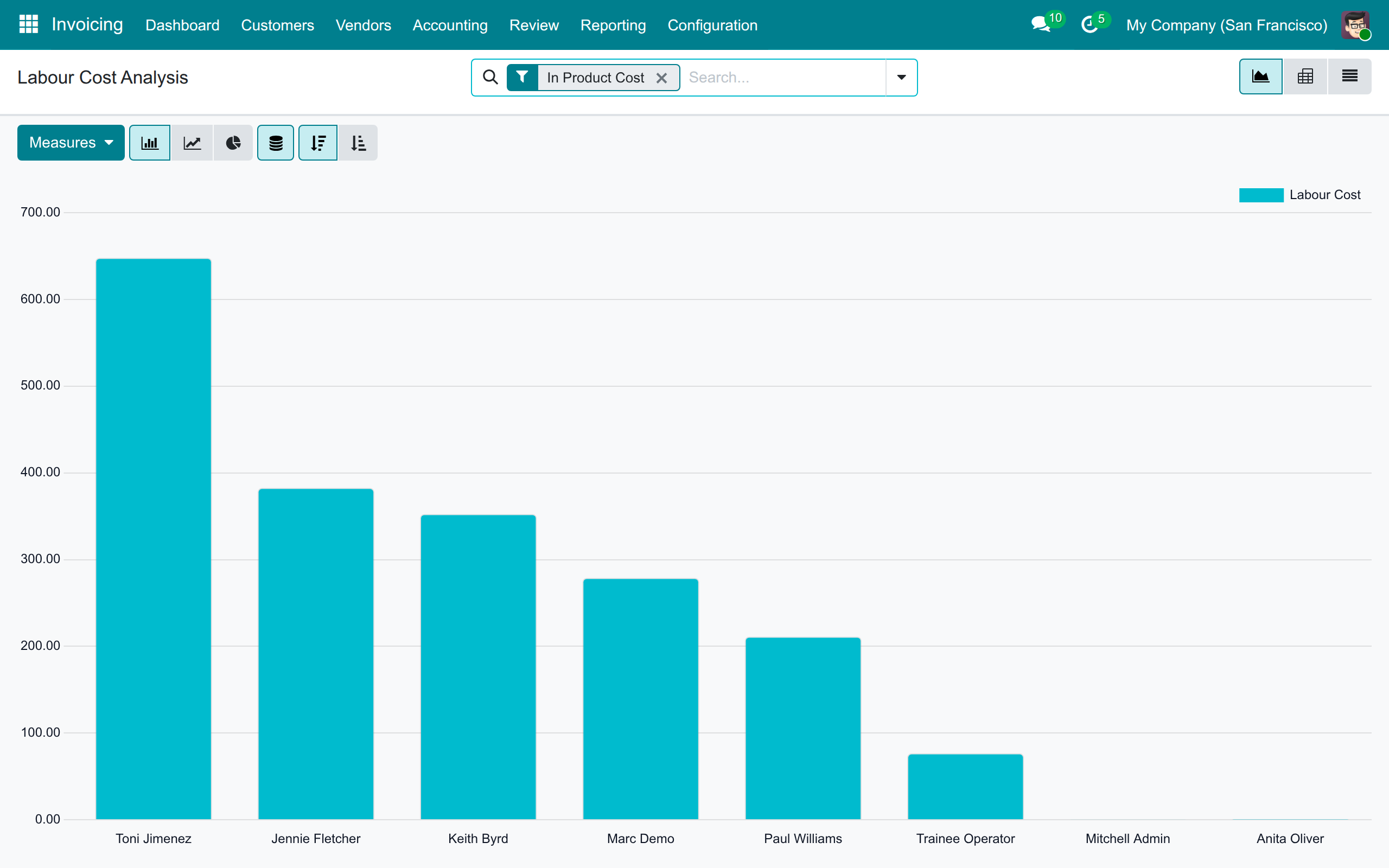
What labour cost went into our products, by employee, month, work center and order?
Invoicing › Reporting › Manufacturing Reports › Labour Cost Analysis
Closed time at each employee's frozen hourly rate. The cost accountant reconciles it with payroll; the list shows the time costed at the work center's rate.
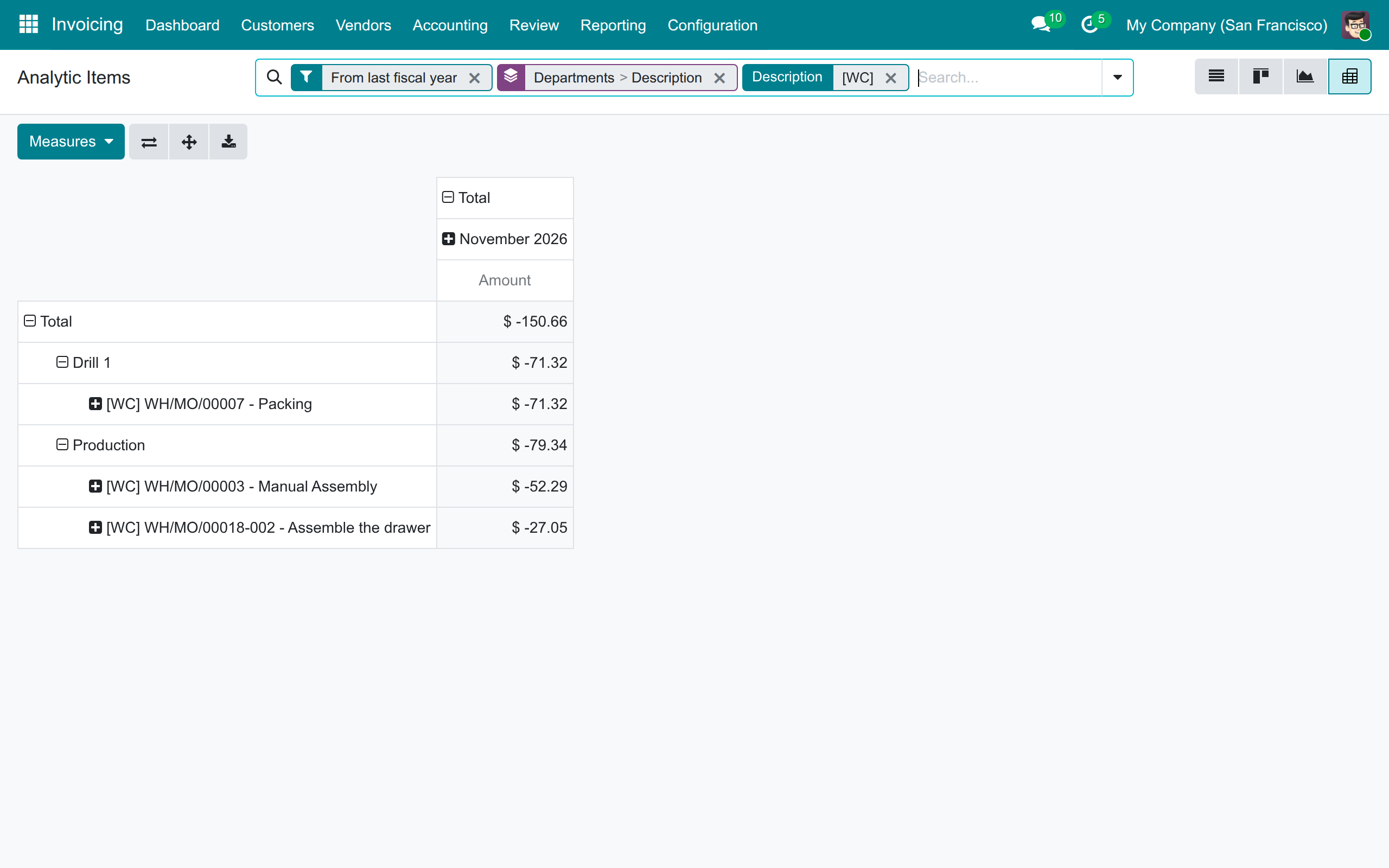
What did each work center cost in machine time and labour, by month?
Invoicing › Accounting › Transactions › Analytic Items
Machine time plus labour of finished work orders, on each work center's analytic account. The cost accountant allocates overhead from these totals.
Labour figures are visible to accounting roles only.
Features
Labour in product cost
- ✓ Direct labour per work order on the Production Cost Report
- ✓ Each person's hourly cost, frozen when the time closes
- ✓ Work center rate for employees without one
- ✓ Machine hours counted once
Labour reporting
- ✓ Labour Cost Analysis by employee, month, work center, order and product
- ✓ Stop and quality time kept apart from product cost
- ✓ Filters for work center rate and time recorded on behalf
Work in progress
- ✓ A WIP analytic account per work center
- ✓ Period-end entry counts each component once
- ✓ A notice for components with no known stock closing
Costing
- ✓ Compute Price from BoM adds the planned employees
- ✓ Operations on theoretical time count planned labour
Built for cost control
- ✓ Labour figures for accounting roles only
- ✓ Posted labour keeps its booked rate
- ✓ Perpetual and periodic valuation
Ready on day one
Installs itself
With both required modules present; existing work centers get a direct-labour column.
Labour report in the menu
Labour Cost Analysis opens on the labour in product cost.
Set first
Manufacturing accounts, Analytic Accounting, and an analytic distribution and WIP analytic account per work center.
Before you decide
Does a pay rise re-price finished work?
No. The hourly cost is frozen on each time line when it closes, and posted labour keeps its booked rate.
Two people at one machine: is machine time counted twice?
No. Machine hours count once; each person's hours go to labour.
Who sees the labour figures?
Accounting roles only, for example Show Accounting Features - Readonly. The period-end entry also needs Show Full Accounting Features and Manufacturing / User.
Is all recorded time in the product cost?
Productive and slow-down time are; stop and quality time are not, but the report lists them without its default filter.
Does it assume a country's chart of accounts?
No. It books to the accounts your company configures, on any chart of accounts.
Try it, then ask us
The video above shows it at work; the Documentation tab covers each role's tasks. Live demo: v19demo-int.viindoo.com
Pre-sales & partnership
viindoo.com/contactusTechnical support
viindoo.com/ticketShop Floor Control - Accounting
Note
Extends Shop Floor Control - see its documentation. It also builds on Advanced MRP Accounting - see its documentation.
Who this guide is for. Cost accountants and accounting managers who read and book the cost of manufacturing, production managers who prepare work centers and operations, and the administrator who sets the module up.
Shop Floor Control - Accounting carries the labour credited to each employee on the shop floor into the cost of your manufacturing orders. The direct labour of every work order appears on the Production Cost Report at the hourly cost of the employees who did the work, the analytic entries of a work center include that labour, a work center can track the value of the components it consumes on its own analytic account, Compute Price from BoM adds the employees of each operation, and the period-end work-in-progress entry counts each component once.
The screenshots show the demo company. Mitchell Admin signs in, Marc Demo, Anita Oliver, Paul Williams and Jennie Fletcher are employees who are credited with time, and the Table Top is made from two Wood Panel on the work center Assembly 1.
Overview
The module adds one report menu, Labour Cost Analysis. It also makes the screens you already use for manufacturing and accounting carry the labour of the shop floor:
- Direct labour. The labour of a work order is the time of each closed time line multiplied by the hourly cost of the employee credited on that line. The hourly cost is frozen when the line closes, so a later change to an employee's hourly cost never re-prices finished work. An employee who has no hourly cost of their own is priced at the Employee Hourly Cost of the work center.
- Machine time. The cost of the work center itself is its Cost per hour multiplied by the machine hours. When several employees work at the same time, the machine hours are counted once, and the line holds the machine only: the labour is on the direct-labour line.
- Analytic accounts. A finished work order writes one analytic line on the Analytic Distribution of its work center, with the machine cost plus the labour. A work center that has a WIP Analytic Account also tracks the value of the components it consumes, until the finished products are received.
- Labour cost report. The report Labour Cost Analysis lists every closed time line with the employee it is credited to, by employee, month, work center and order, so the labour that entered the cost of the orders can be compared with payroll.
- Price from the bill of materials. The cost of an operation adds the planned employees to the work center: expected duration multiplied by the Employee Capacity of the operation multiplied by the Employee Hourly Cost of the work center.
- Period-end entry. The work-in-progress entry counts each component of an order in progress once, by where the accounts hold its value at the date of the entry, under perpetual and periodic valuation.
The work moves through four stages:
| Stage | What happens | Who acts | Hand-off |
|---|---|---|---|
| 1 | Install the module, turn on analytic accounting and set the manufacturing accounts | Administrator | The production manager prepares the work centers |
| 2 | Set the cost fields of the work centers and the employees of the operations, price a product from its bill of materials | Production manager | Operators record their time on the shop floor; the cost accountant reads the result |
| 3 | Read the direct labour on the Production Cost Report, analyse it per employee in the Labour Cost Analysis and follow labour and work in progress on the analytic items | Cost accountant | The accounting manager closes the period |
| 4 | Post the work-in-progress entry | Accounting manager |
| Role | What they do | Access right to assign |
|---|---|---|
| Administrator | Installs the module, turns on analytic accounting, sets the manufacturing accounts, assigns the access rights | Role / Administrator, and Show Full Accounting Features to see the accounting settings |
| Production manager | Edits work centers and operations, runs Compute Price from BoM | Manufacturing / Administrator |
| Cost accountant | Reads the Production Cost Report, the Labour Cost Analysis and the analytic items | Show Accounting Features - Readonly |
| Accounting manager | Posts the work-in-progress entry | Accounting / Administrator, Show Full Accounting Features and Manufacturing / User |
Setup (for the Administrator)
Installation
The module installs itself when Shop Floor Control and Advanced MRP Accounting are both installed. To get both from Shop Floor Control:
Open Manufacturing ‣ Configuration ‣ Settings.
In the section Operations, tick Shop Floor Control - Accounting. It installs Advanced MRP Accounting and the accounting apps it needs. The box is already ticked when the module is installed.
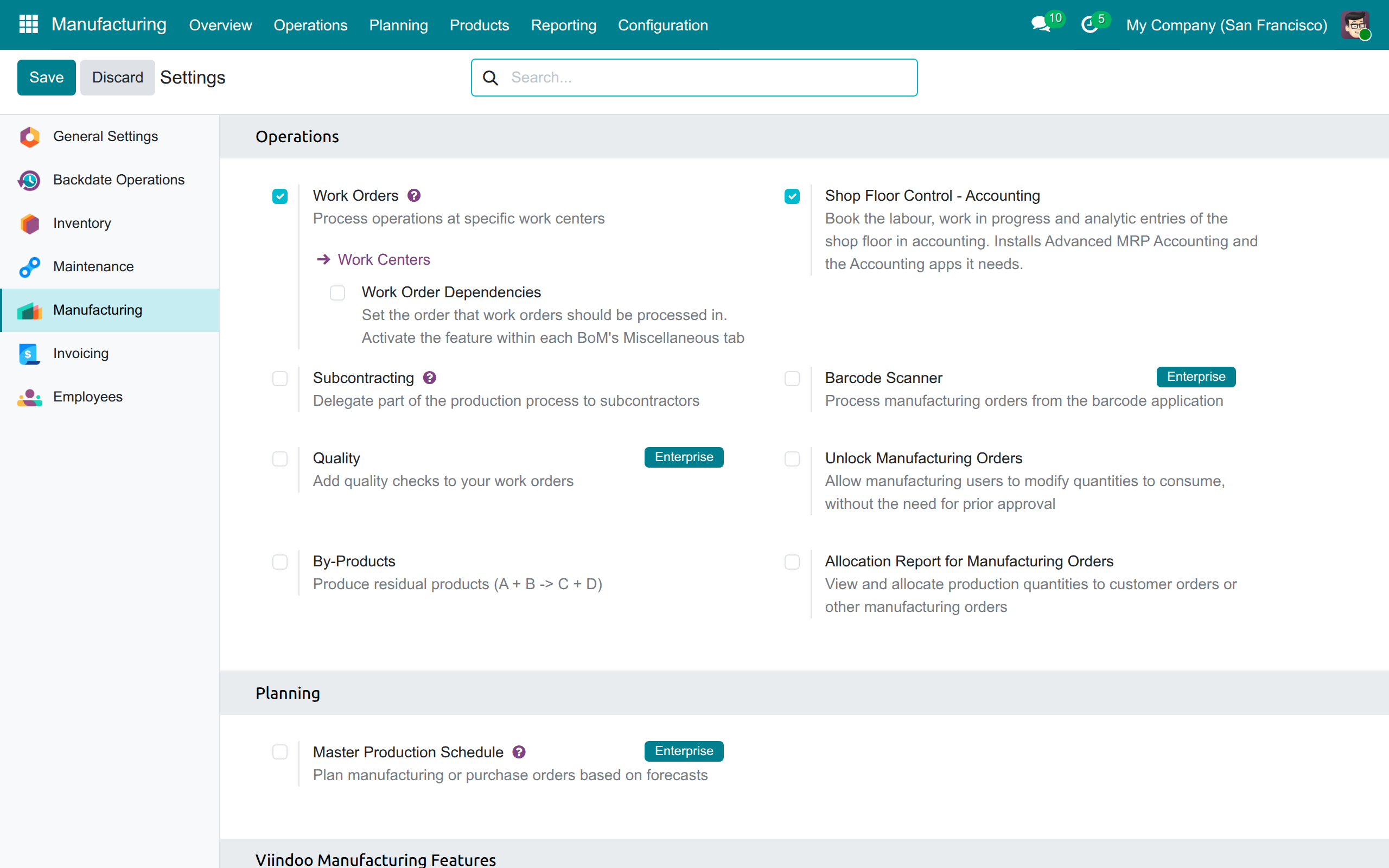
Click Save.
A work center always has a Direct Labor Cost Type: a work center created without one receives the first Direct Labor cost type of its company, and so does every work center that exists when the module is installed.
Accounting settings
The settings below appear for users who hold the access right Show Full Accounting Features.
Open Invoicing ‣ Configuration ‣ Settings.
In the section Manufacturing Accounts, set the accounts of manufacturing:
- Cost of Production is the account of the production location. The value of a component consumed by an order passes through it when the stock valuation is perpetual.
- Production WIP Account is the account the period-end entry debits.
- Production WIP Overhead Account is the account the period-end entry credits with the work center time and the labour.
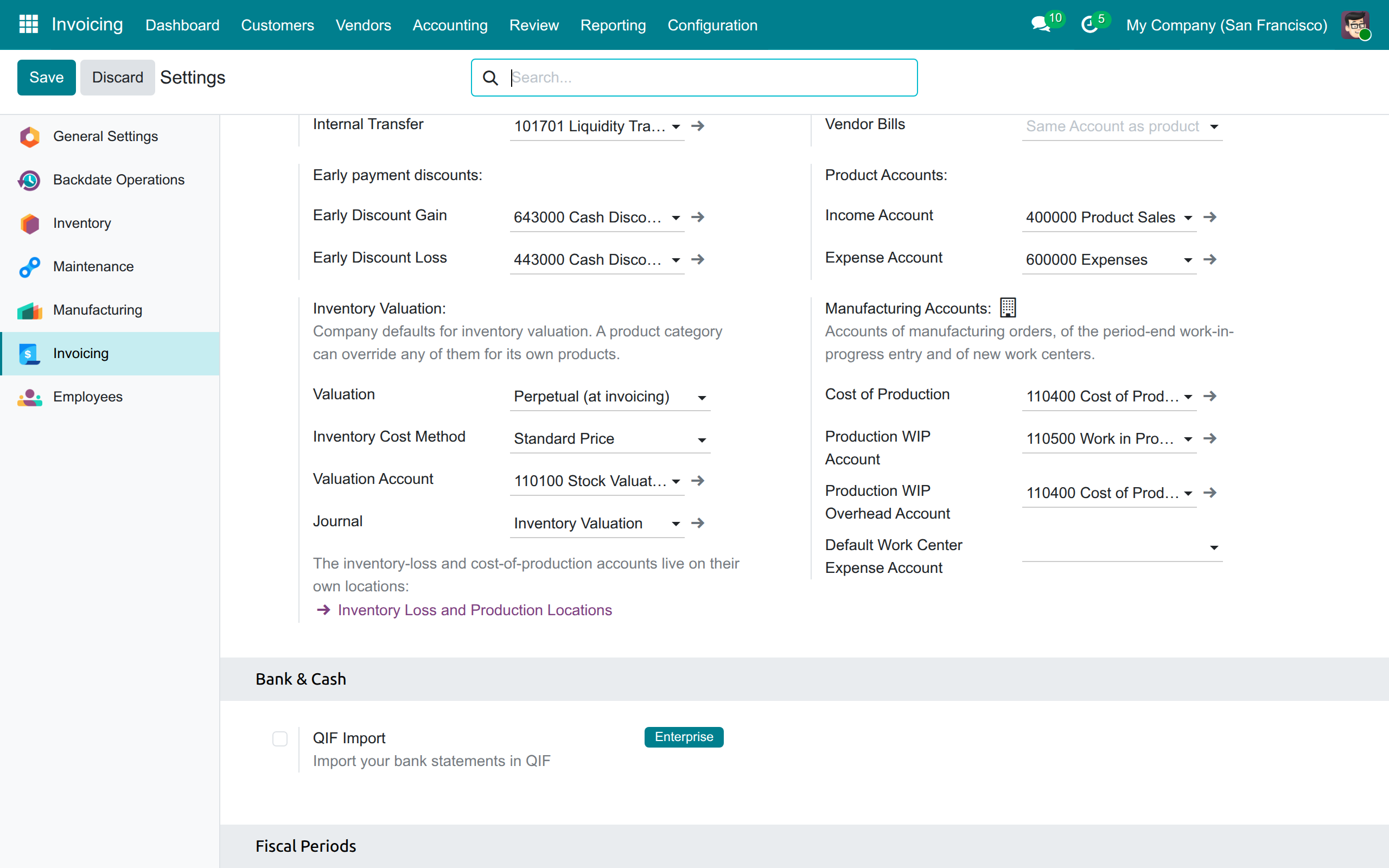
The module works with both valuations of the field Valuation, Periodic (at closing) and Perpetual (at invoicing). The examples of this guide use the perpetual one.
In the section Analytics, tick Analytic Accounting. The fields Analytic Distribution and WIP Analytic Account of a work center appear for users who have this option.
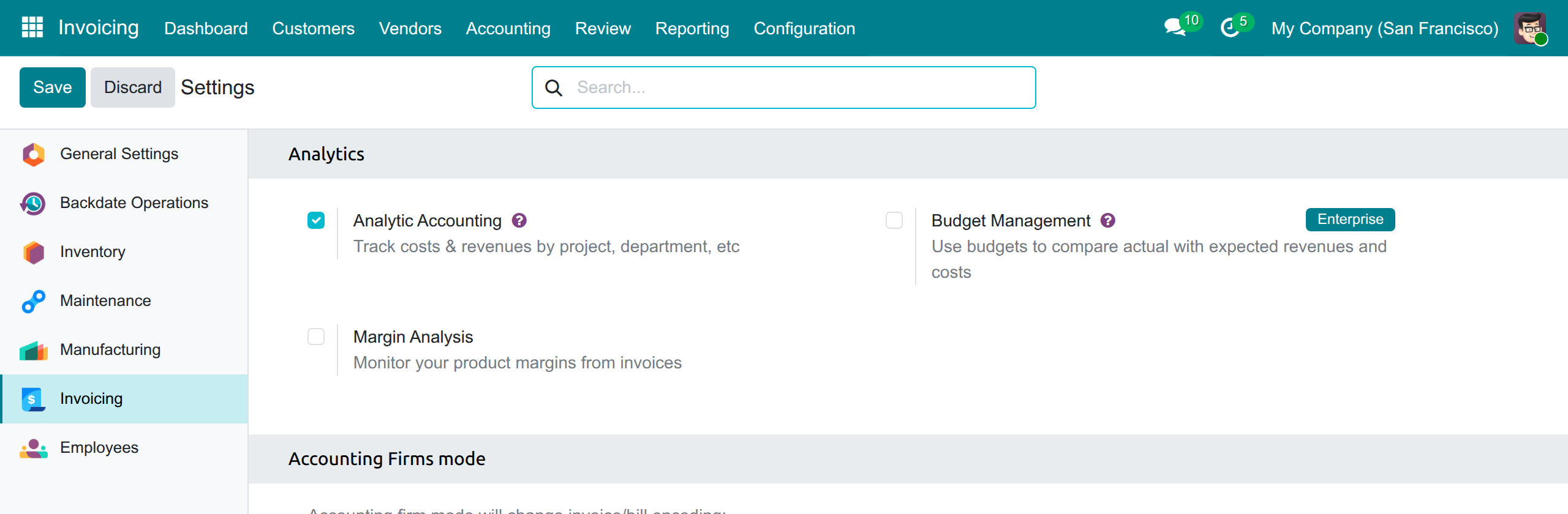
Click Save.
Access rights
Open Settings ‣ Users & Companies ‣ Users and give each person the access right of their role, as listed in the table of the Overview. The two accounting rights Show Accounting Features - Readonly and Show Full Accounting Features are listed in the user form only when the developer mode is on; the second includes the first. The administrator and the superuser hold Show Accounting Features - Readonly.
The accounting manager also needs Manufacturing / User: without it the manufacturing orders are closed to that person and the entry cannot be opened.
Tasks for the production manager
Choose where the labour of a work center is reported and tracked
Open Manufacturing ‣ Configuration ‣ Work Centers and open a work center, for example Assembly 1.
Scroll to Costing Information.
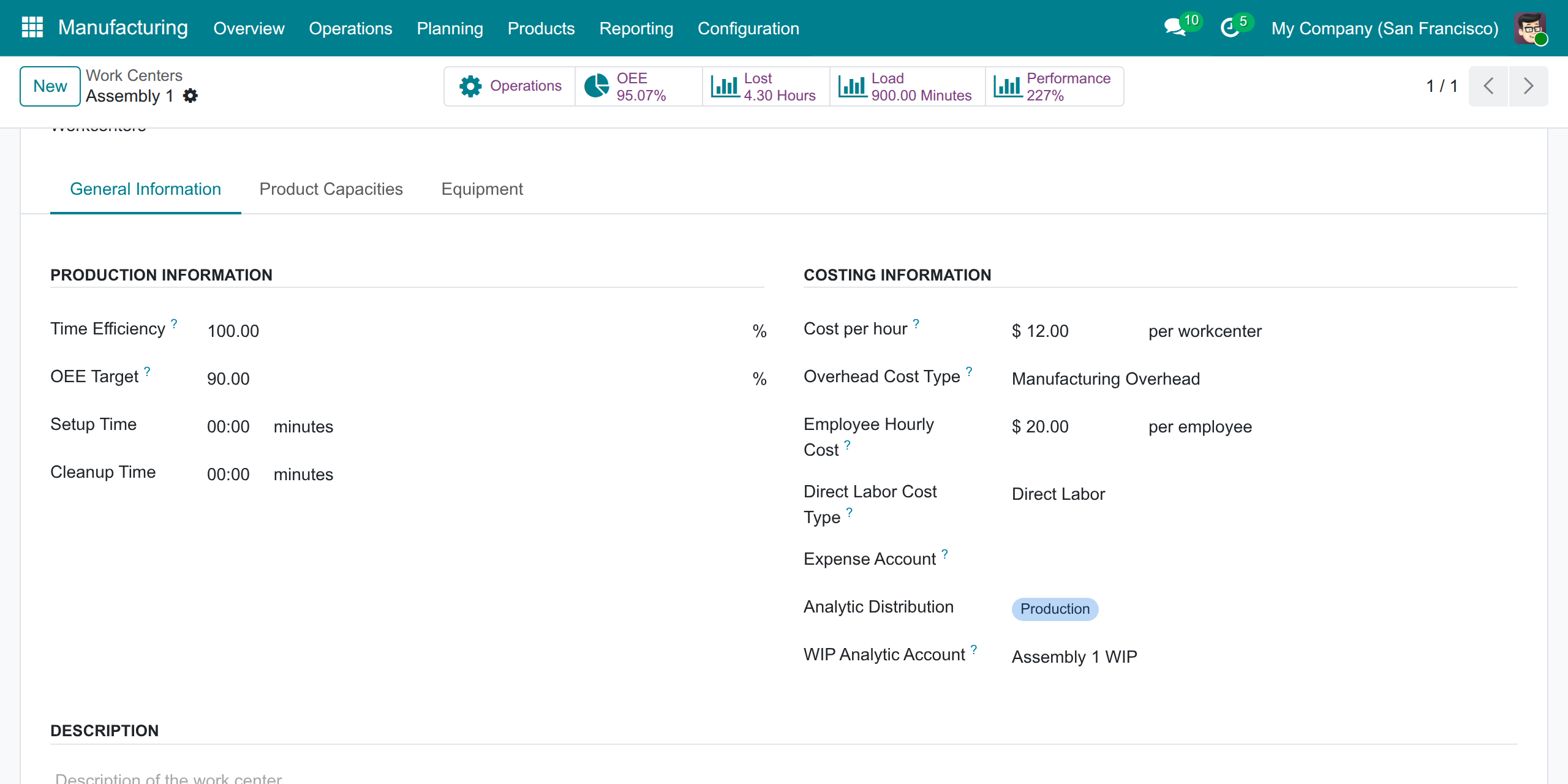
Check the fields that decide how the work center is costed:
- Cost per hour is the cost of the work center itself, and Overhead Cost Type is the column of the Production Cost Report that shows it.
- Employee Hourly Cost (per employee) is the hourly cost used for an employee who has no hourly cost of their own. It also prices the planned employees of an operation.
- Direct Labor Cost Type is the column of the Production Cost Report that shows the labour of this work center. It is Direct Labor by default. The columns are the cost classifications of Invoicing ‣ Configuration ‣ Classification of Manufacturing Cost.
- Analytic Distribution is the analytic account that receives the cost lines of the work center, including its labour.
- WIP Analytic Account is the analytic account that tracks the work in progress of this work center: the components it consumes, until the finished products are received. Leave it empty to not track it.
Click Save.
Price a product from its bill of materials
Compute Price from BoM adds the planned employees of each operation to the cost of the components and of the work centers. The cost of an operation is its expected duration multiplied by the Cost per hour of its work center, plus the same duration multiplied by its Employee Capacity and by the Employee Hourly Cost of the work center.
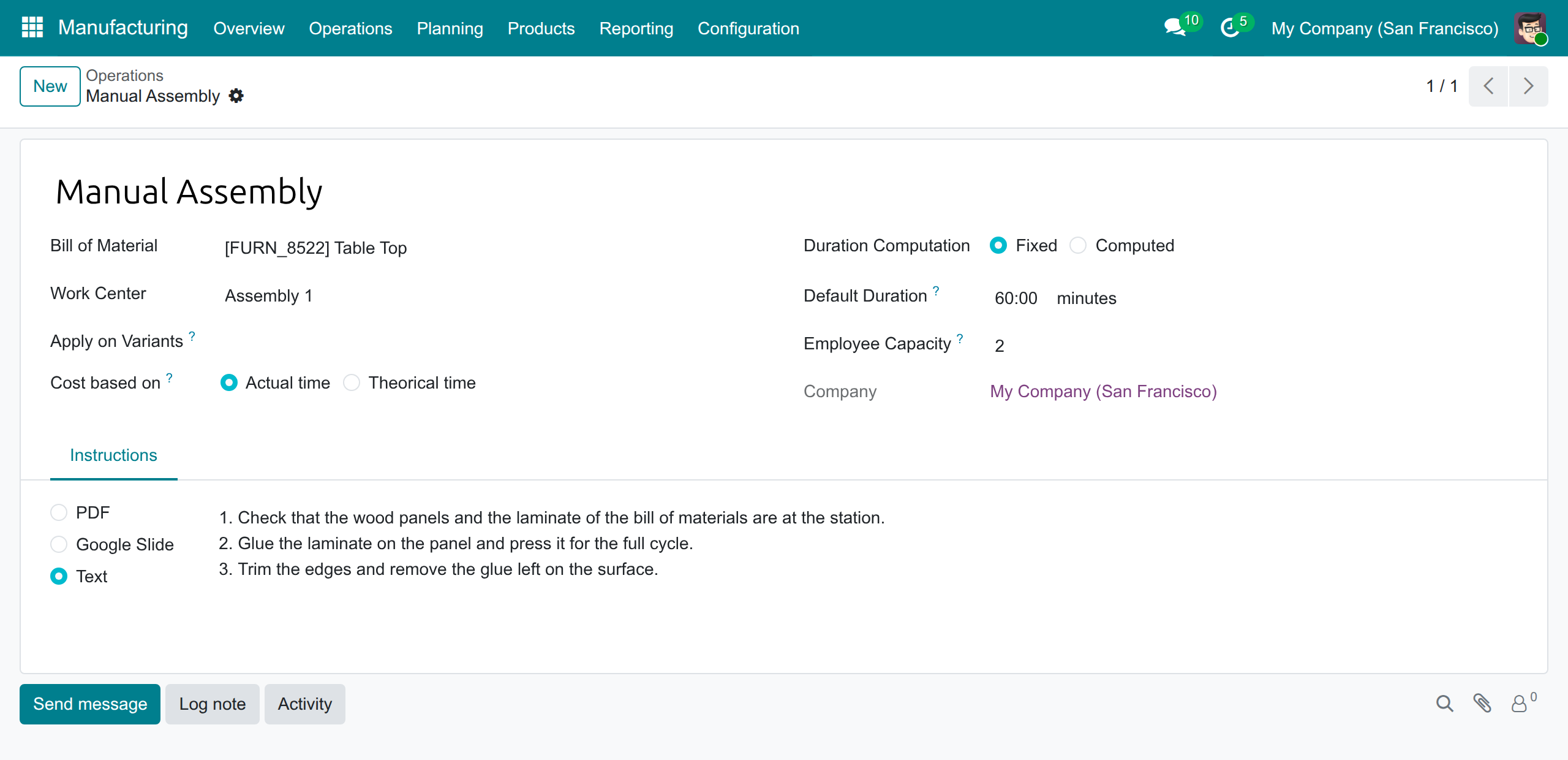
Open Manufacturing ‣ Configuration ‣ Operations and open an operation, for example Manual Assembly. Employee Capacity is the number of employees the operation needs, here 2, and Default Duration is 60:00 minutes.
Open Manufacturing ‣ Products ‣ Products and open the manufactured product, for example Table Top.
Next to Cost, click Compute Price from BoM.
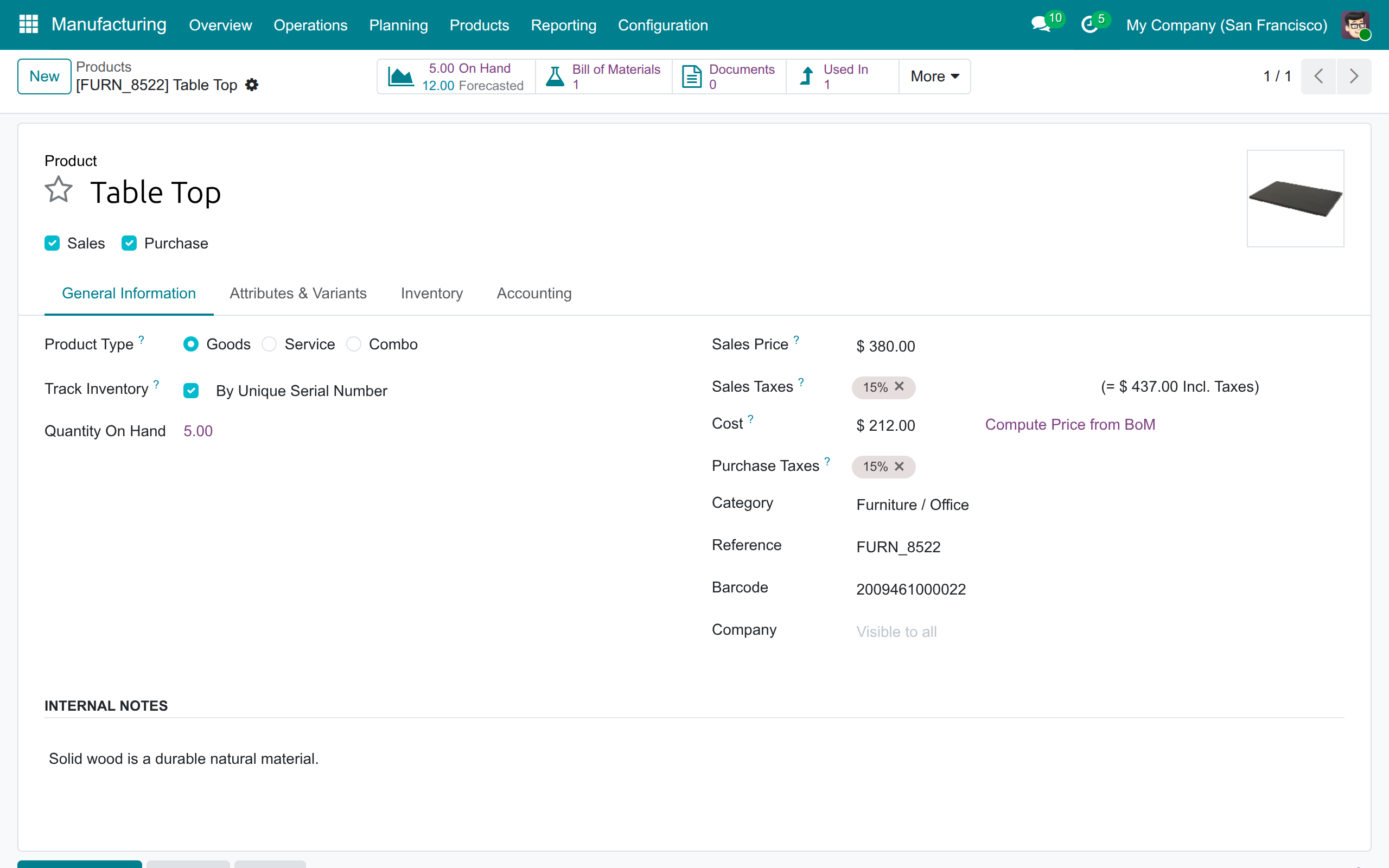
The cost of the Table Top is 212.00:
- Components: 2 Wood Panel at 80.00, 160.00.
- Work center time: 1 hour on Assembly 1 at 12.00, 12.00.
- Employees: 1 hour for 2 employees at 20.00, 40.00.
An operation whose field Cost based on is Theorical time counts its labour on the plan in the same way when the order is costed: expected duration multiplied by the employees multiplied by the Employee Hourly Cost. An operation costed on Actual time counts the time lines of the employees.
Tasks for the cost accountant
What labour cost entered the product cost, per employee, month, work center and order?
Use Labour Cost Analysis to reconcile the labour of the shop floor with payroll and to find time that was costed at the fallback rate. Each row is one closed time line with the employee it is credited to: its hours, its hourly rate frozen when the line closed, and its cost, which is the hours multiplied by that rate.
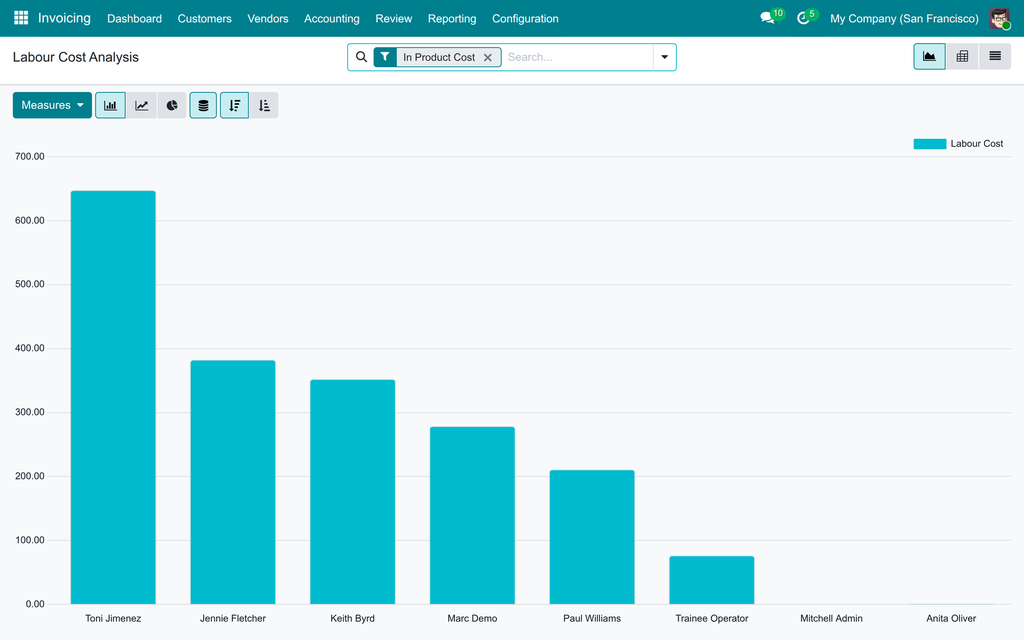
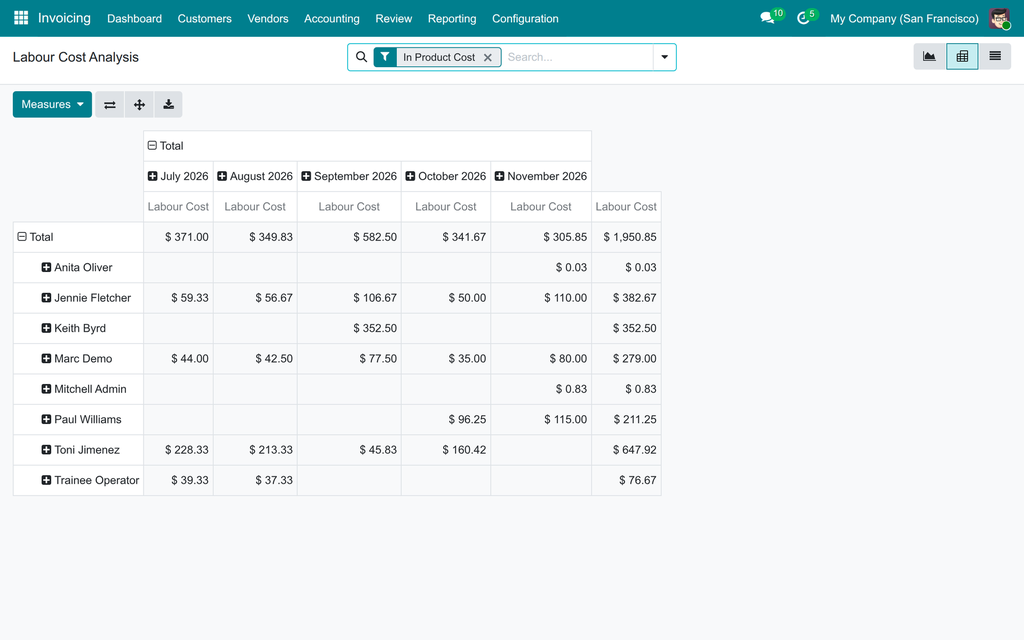
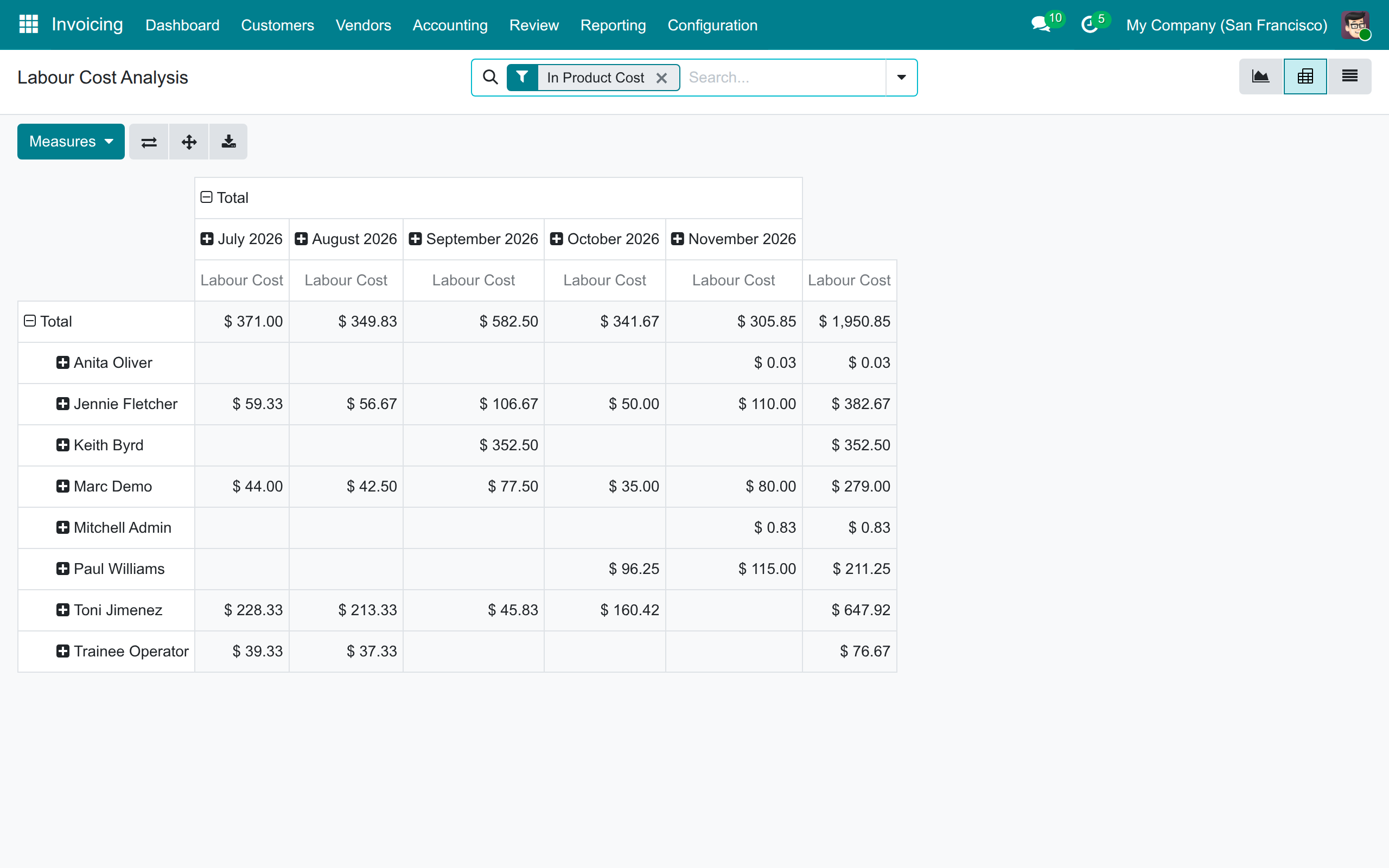
Open Invoicing ‣ Reporting ‣ Manufacturing Reports ‣ Labour Cost Analysis. The report opens as a bar chart of the Labour Cost of each employee, with the filter In Product Cost: the total of the bars is the labour that entered the cost of the orders.
Click the pivot view. The rows are the employees and the columns are the months, so one screen answers who cost how much in which month. In the sample, the five months from July to November 2026 add up to 1,950.85, and Toni Jimenez is the largest of the eight employees with 647.92. The small November amounts of Anita Oliver and Mitchell Admin are short time lines recorded on the shop floor.
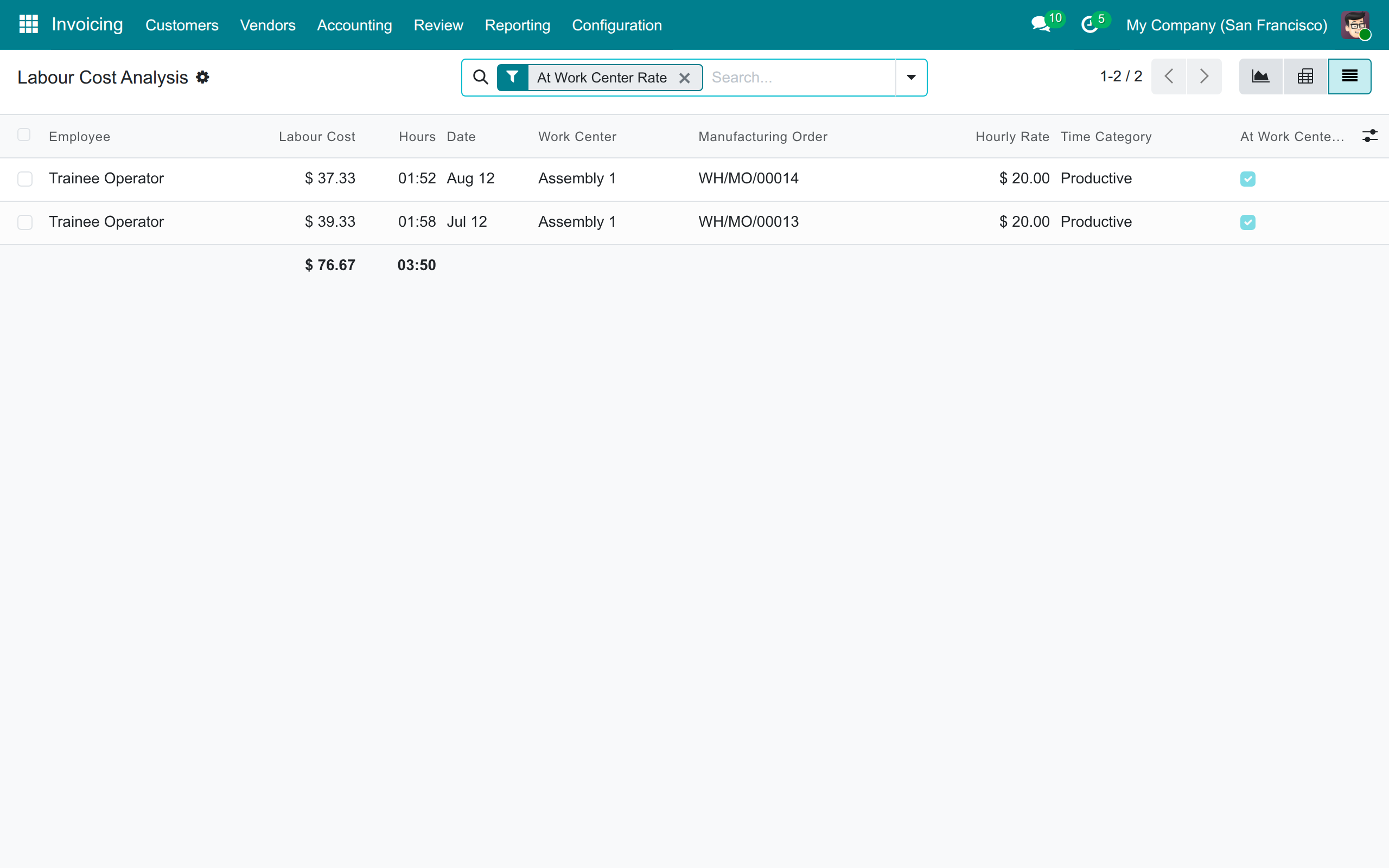
Regroup the report with the search options Employee, Work Center, Manufacturing Order, Product, Time Category and Month, or open the list view to see the lines themselves. The list shows Employee, Labour Cost, Hours and Date; the column selector at the right of the header adds Work Center, Manufacturing Order, Work Order, Product, Hourly Rate, Time Category, In Product Cost, At Work Center Rate and Recorded on Behalf.
Use the filters to answer the questions of the period close:
- In Product Cost is on by default. It keeps the productive time and the time that slowed the work down, which is the labour that entered the cost of the orders. Remove it to also see the Time Category Availability, the stop time that is paid but not costed.
- At Work Center Rate keeps the lines whose employee had no hourly cost of their own, so the Employee Hourly Cost of the work center was used. In the sample, these are two lines of Trainee Operator at 20.00, 76.67 in total.
- Recorded on Behalf keeps the time recorded by someone else, for example the foreman, for the employee it is credited to.
Note
Labour Cost Analysis is for accounting roles only: it is in the menu of users who hold an accounting access right such as Show Accounting Features - Readonly. Production managers and team leaders who hold no accounting access right do not see the report or the cost of labour. A time line that is still open, or that has no credited employee, is not in the report.
Read the direct labour of finished orders
The labour of a work order is the time of each closed time line multiplied by the hourly cost of the employee credited on that line. That hourly cost is frozen when the line closes: a later change of an employee's hourly cost never re-prices work that is finished.
Open Invoicing ‣ Reporting ‣ Manufacturing Reports ‣ Production Cost Report. Users who hold the accounting right but are not Manufacturing administrators also find the same report under Manufacturing ‣ Reporting ‣ Production Cost Report.
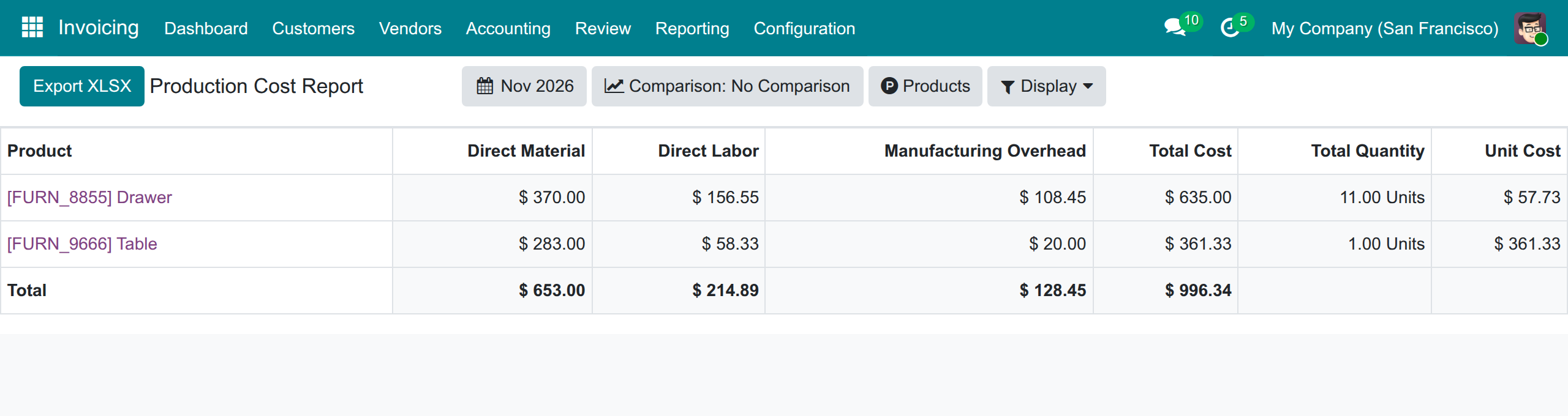
Pick the period with the date button. The report lists the products of the orders finished in that period. The column Direct Labor is the labour of those orders, the column Manufacturing Overhead is the time of the work centers.
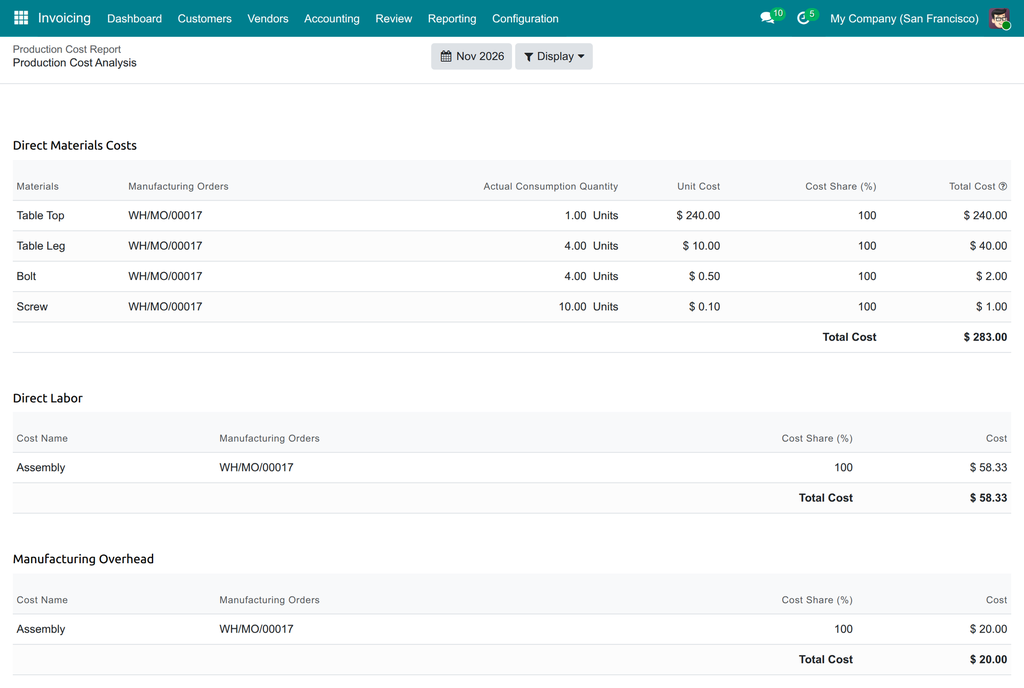
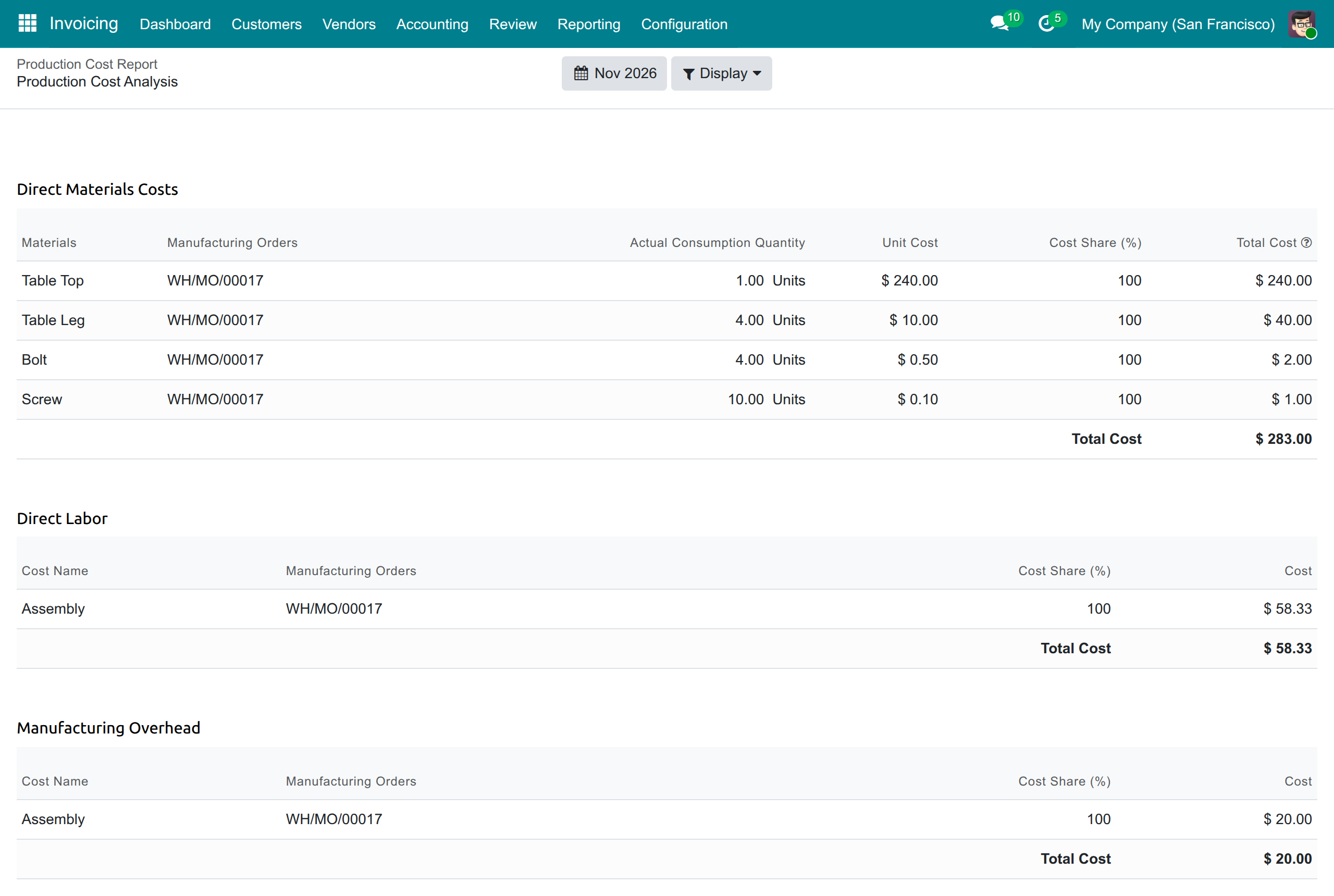
Click a product, for example Table, to open the Production Cost Analysis. In the section Direct Labor, each row is one work order of the finished order.
In the sample, the order WH/MO/00017 assembled the Table in 100 minutes. Paul Williams (hourly cost 15.00) and Jennie Fletcher (hourly cost 20.00) were each credited with the 100 minutes, so the Direct Labor row is 25.00 plus 33.33, 58.33. The time of the work center is counted once, 100 minutes at 12.00, and is the Manufacturing Overhead row, 20.00.
Note
An employee who has no hourly cost of their own is priced at the Employee Hourly Cost of the work center, and that rate is frozen on the time line when the line closes. To price an employee at their own rate, enter the Hourly Cost in the settings of the employee.
Once the labour of a work order has been posted to accounting, correcting the credited employee of one of its time lines does not re-price the line: it keeps the rate that was booked.
Follow labour and work in progress on analytic items
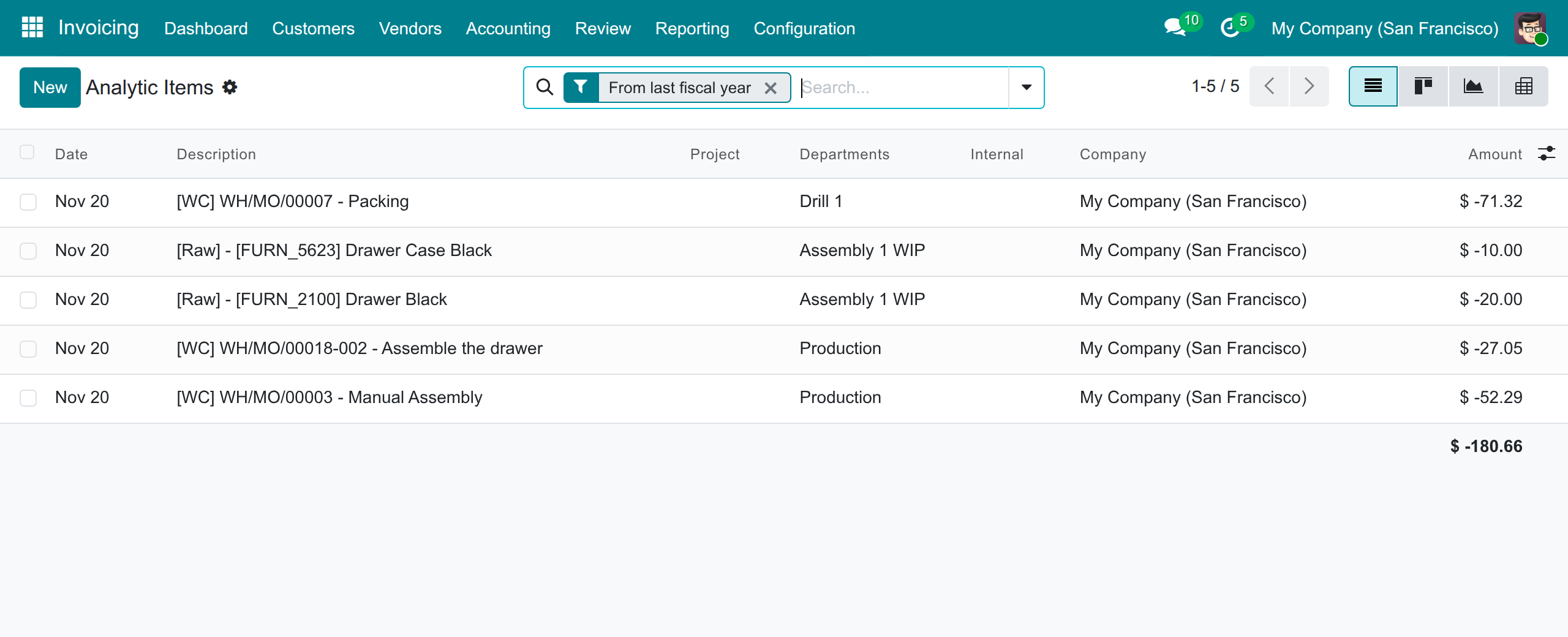
Open Invoicing ‣ Accounting ‣ Transactions ‣ Analytic Items. The list needs the option Analytic Accounting. The list opens with the filters From last fiscal year and P&L Accounts; remove P&L Accounts, because the lines of manufacturing carry no financial account.
Labour in the analytic entry of the work center. When a work order is finished, its work center writes one line for it on its Analytic Distribution, named [WC] followed by the order and the operation. The amount is the cost of the work center time plus the labour of the time lines at their frozen rates, and the quantity is the hours worked, counted once. A work center whose Cost per hour is zero still receives the labour line. When your manufacturing orders belong to projects through the application MRP Account Project, the analytic line of the order on the project carries the same amount.
Work in progress of the work center. When a component is consumed in a work order whose work center has a WIP Analytic Account, the consumption writes a line with the name starting with [Raw] on that account, with a negative amount. The component belongs to the operation that consumes it, or to the last operation of the order when its bill of materials line has no operation. When the finished product is received with a value, a line with the opposite amount offsets it. Until the receipt, the account holds the value of the components still in progress. These lines exist under both valuations.
Search the Description for [WC] to keep the lines of the work centers, for [Raw] to keep the lines of the components, or for the name of a component.
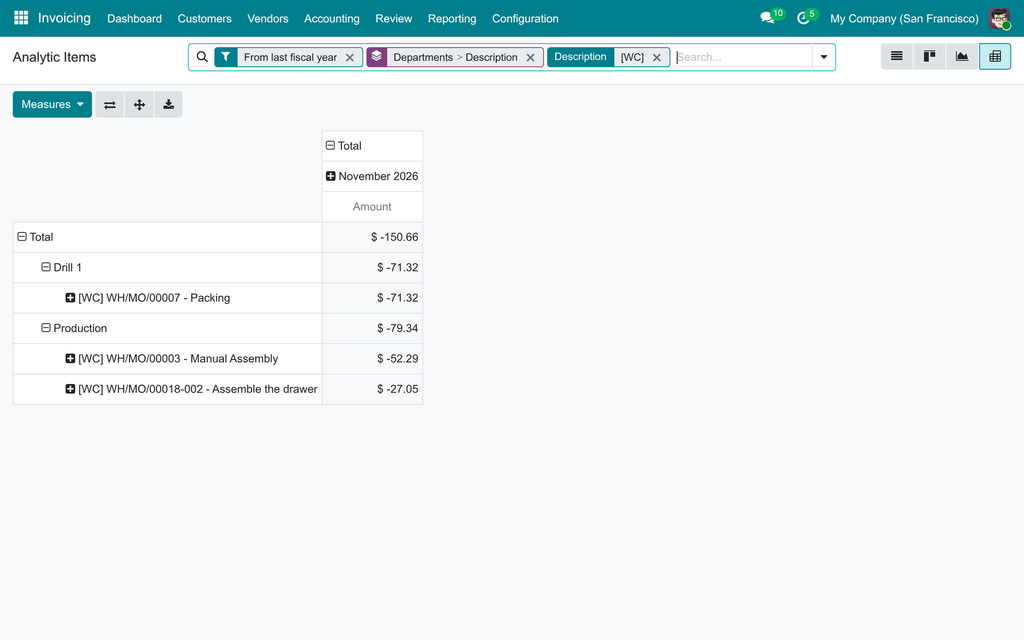
In the sample, the work center line of WH/MO/00018-002 is -27.05 for 1.00 hour on the account Production: 12.02 for the hour of the work center at 12.00, plus 15.03 of labour, 15.00 for Paul Williams (60 minutes at 15.00) and 0.03 for a few seconds credited to Anita Oliver. The two components of the order, Drawer Black and Drawer Case Black, are -20.00 and -10.00 on the account Assembly 1 WIP. The order is still in progress, so these lines have no offsetting line yet: the account holds 30.00 for it until the finished products are received.
When the consumption of a finished order is corrected afterwards, the lines of the work in progress follow it, so that the account stays at zero for that order.
What did each work center cost in machine time and labour, by month?
The [WC] lines of the analytic items answer this question by the analytic account of each work center. Each line holds the cost of the work center time plus the labour of the order, so the totals are the part of manufacturing that the work centers put into the analysis.
Open Invoicing ‣ Accounting ‣ Transactions ‣ Analytic Items and switch to the pivot view.
Remove the filter P&L Accounts and search the Description for [WC].
In Group By, choose the analytic plan that holds the accounts of your work centers, here Departments, then Custom Group ‣ Description to see the line of each order. The columns are the months.
In the sample, the account Production of the work center Assembly 1 holds -79.34 and the account Drill 1 of the work center Drill 1 holds -71.32, -150.66 in total for November 2026. The lines exist from the moment the work center has an Analytic Distribution: the work orders that closed time before that have no line.
Tasks for the accounting manager
Post the period-end work-in-progress entry
The period-end entry puts the value of the orders still in progress into the work-in-progress account. A component can reach accounting earlier, with Post Consumption on its work order. The entry takes that into account and does not count the component twice.
Open Manufacturing ‣ Operations ‣ Work Orders and open a work order that is in progress. Click Post Consumption to post the components already picked for it.
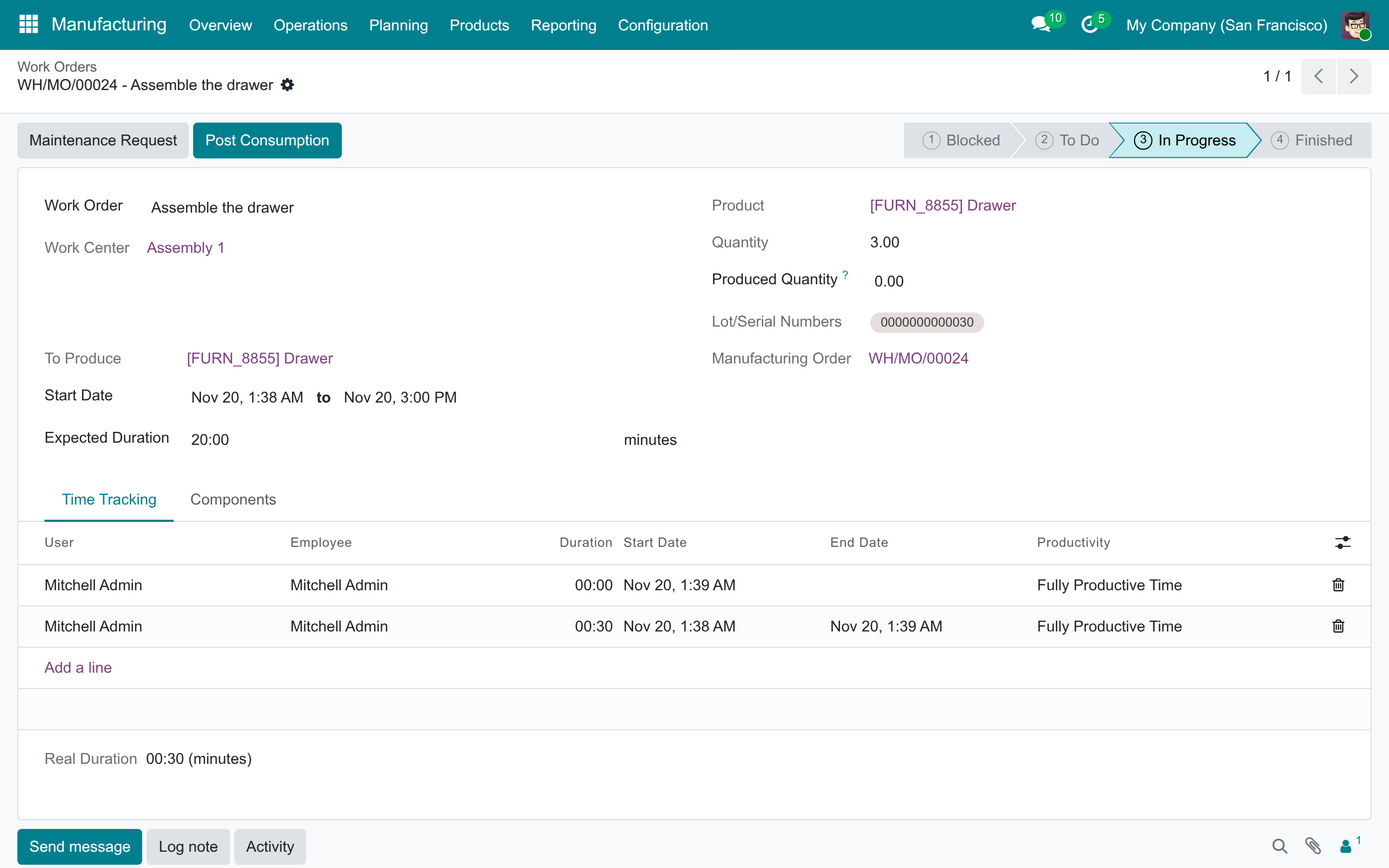
Open Manufacturing ‣ Operations ‣ Manufacturing Orders and open the order. In the gear menu, choose Post WIP Accounting Entry. The action needs Show Full Accounting Features.
Check the Journal, the Reference, the Date and the Reversal Date, then check the lines. The Date is the date at which the components are counted: a component posted with Post Consumption after that date is still counted in stock at the date.
Click Post WIP. The entry is reversed on the Reversal Date, by default the next day.
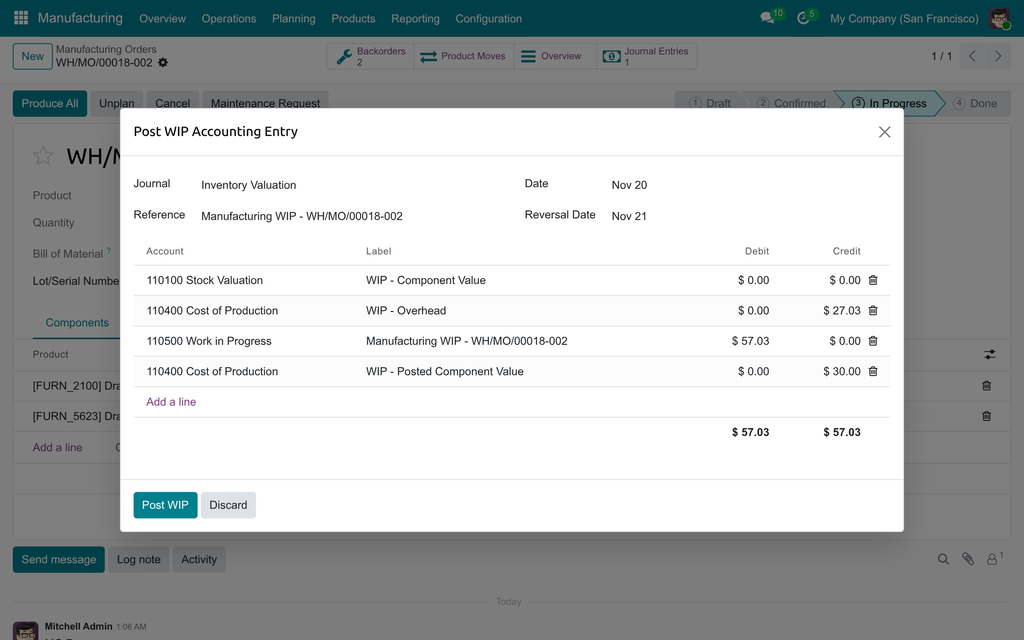
In the sample, the two components of the order WH/MO/00018-002, Drawer Black (20.00) and Drawer Case Black (10.00), were posted with Post Consumption, and the time of the order is 27.03. With the date of the entry on or after the day they were posted, the lines read:
- WIP - Component Value: 0.00. The components are already posted, so the stock account is not credited again.
- WIP - Overhead: credit 27.03, the work center time plus the labour of the closed time lines up to the date.
- Manufacturing WIP followed by the order: debit 57.03 on the work-in-progress account.
- WIP - Posted Component Value: credit 30.00, on the account of the production location where the posted components sit, so that their value moves into work in progress.
Three cases are handled in the component lines:
- A component already posted with Post Consumption is taken off the credit of the stock accounts. When its posted value sits on an account other than the stock valuation account and the work-in-progress account, a line WIP - Posted Component Value moves that value into work in progress from the account that holds it.
- A component posted while the database had no stock valuation, for example before accounting was installed, never reached a stock account. It is not credited from stock either.
- A component that is still in stock at the date of the entry is credited from the stock account, as for any order in progress.
The wizard shows a notice above the lines when a component stays in stock only because the company has no stock closing up to the date of the entry while it has a later one: No stock closing up to this date is known for the components, so the entry keeps them in stock. If an earlier closing took them out of stock, adjust the lines before posting. The notice does not block the posting.
You can still edit the lines before you click Post WIP: the amounts and accounts are posted as typed.
Troubleshooting
| Symptom | What to check |
|---|---|
| The labour of an order is zero | The employee credited on the time lines has no Hourly Cost and the Employee Hourly Cost of the work center is zero. Enter one of them. Finished and posted lines keep the rate they were closed with. |
| The labour of a work center is not in the column you expect | The Direct Labor Cost Type of the work center decides the column of the Production Cost Report. |
| There is no WIP Analytic Account field on the work center | Analytic Accounting is off in the Invoicing settings. |
| A component has no work-in-progress line | The work center that consumes it has no WIP Analytic Account, or no work order consumes it. The offset line appears only after the finished products are received with a value. |
| The Analytic Items list is empty | Remove the filter P&L Accounts: the lines of manufacturing carry no financial account. |
| Post WIP Accounting Entry is not in the gear menu | The user needs Show Full Accounting Features, and Manufacturing / User to open the order. |
| The Production Cost Report is not in the menu | The user needs Show Accounting Features - Readonly or Show Full Accounting Features. |
| The Labour Cost Analysis is not in the menu | The report is for accounting roles: the user needs an accounting access right such as Show Accounting Features - Readonly. |
| A time line is missing from the Labour Cost Analysis | The report lists closed time lines that have a credited employee. Close the time line and credit an employee on it. The filter In Product Cost also hides stop time. |
FAQ
- Does a change of an employee's hourly cost change the labour of finished orders?
- No. The hourly cost is frozen on each time line when it closes.
- Are the hours of two employees working together added to the machine time?
- No. The machine time of the work center is counted once. The hours of each employee are in the labour.
- Does the module work when the company values its stock periodically?
- Yes. The work-in-progress entry counts each component once under perpetual and periodic valuation, by where the accounts hold its value at the date of the entry.
- Does stop time enter the cost of an order?
- No. Time with the Time Category Availability is paid but kept out of the product cost. Remove the filter In Product Cost of the Labour Cost Analysis to see it.
- Where do I change the account that receives the labour of a work center?
- The labour is on the Analytic Distribution of the work center, and in the Production Cost Report under its Direct Labor Cost Type.
This software and associated files (the "Software") may only be used (executed, modified, executed after modifications) if you have purchased a valid license from the authors, typically via Odoo Apps, or if you have received a written agreement from the authors of the Software (see the COPYRIGHT file).
You may develop Odoo modules that use the Software as a library (typically by depending on it, importing it and using its resources), but without copying any source code or material from the Software. You may distribute those modules under the license of your choice, provided that this license is compatible with the terms of the Odoo Proprietary License (For example: LGPL, MIT, or proprietary licenses similar to this one).
It is forbidden to publish, distribute, sublicense, or sell copies of the Software or modified copies of the Software.
The above copyright notice and this permission notice must be included in all copies or substantial portions of the Software.
THE SOFTWARE IS PROVIDED "AS IS", WITHOUT WARRANTY OF ANY KIND, EXPRESS OR IMPLIED, INCLUDING BUT NOT LIMITED TO THE WARRANTIES OF MERCHANTABILITY, FITNESS FOR A PARTICULAR PURPOSE AND NONINFRINGEMENT. IN NO EVENT SHALL THE AUTHORS OR COPYRIGHT HOLDERS BE LIABLE FOR ANY CLAIM, DAMAGES OR OTHER LIABILITY, WHETHER IN AN ACTION OF CONTRACT, TORT OR OTHERWISE, ARISING FROM, OUT OF OR IN CONNECTION WITH THE SOFTWARE OR THE USE OR OTHER DEALINGS IN THE SOFTWARE.