
Tích hợp Kế toán Tài sản với Kho vận
| Số dòng Code | 1497 |
| Tên kỹ thuật | to_stock_asset |
| Giấy phép | OPL-1 |
| Website | https://viindoo.com/apps/modules/19.0/to_stock_asset |
| Đọc mô tả cho | v 12.0 v 13.0 v 14.0 v 15.0 v 16.0 v 17.0 v 18.0 |
| Yêu cầu các App | Invoicing (account) Purchase (purchase) Discuss (mail) Inventory (stock) |
| Bao gồm Các phụ thuộc | Quản lý Tài sản Mô-đun Cơ Sở Viin Kho Vận Nền tảng Kế toán Kế toán kho vận Viin |
| Các mở rộng | Tích hợp Tài Sản, Thiết bị và Kho vận Tài sản qua kho - Nhập lùi ngày |

From the warehouse shelf to the asset register, and back
An Asset Allocation operation that turns lot- or serial-tracked stock into assets - one asset per serial number or lot, at the stock value - plus Return and a Stock In wizard that bring units back to inventory.
Stock Asset (technical name to_stock_asset) is an Odoo 19.0 app for Odoo Community and Viindoo Cloud, built for warehouse, fixed-asset accountant, purchasing, auditor.
At a Glance
The facts of Stock Asset, version 0.1.4, in one place. Published by Viindoo.
How It Works
Transfer serialised units to the asset location; confirm the assets it created.
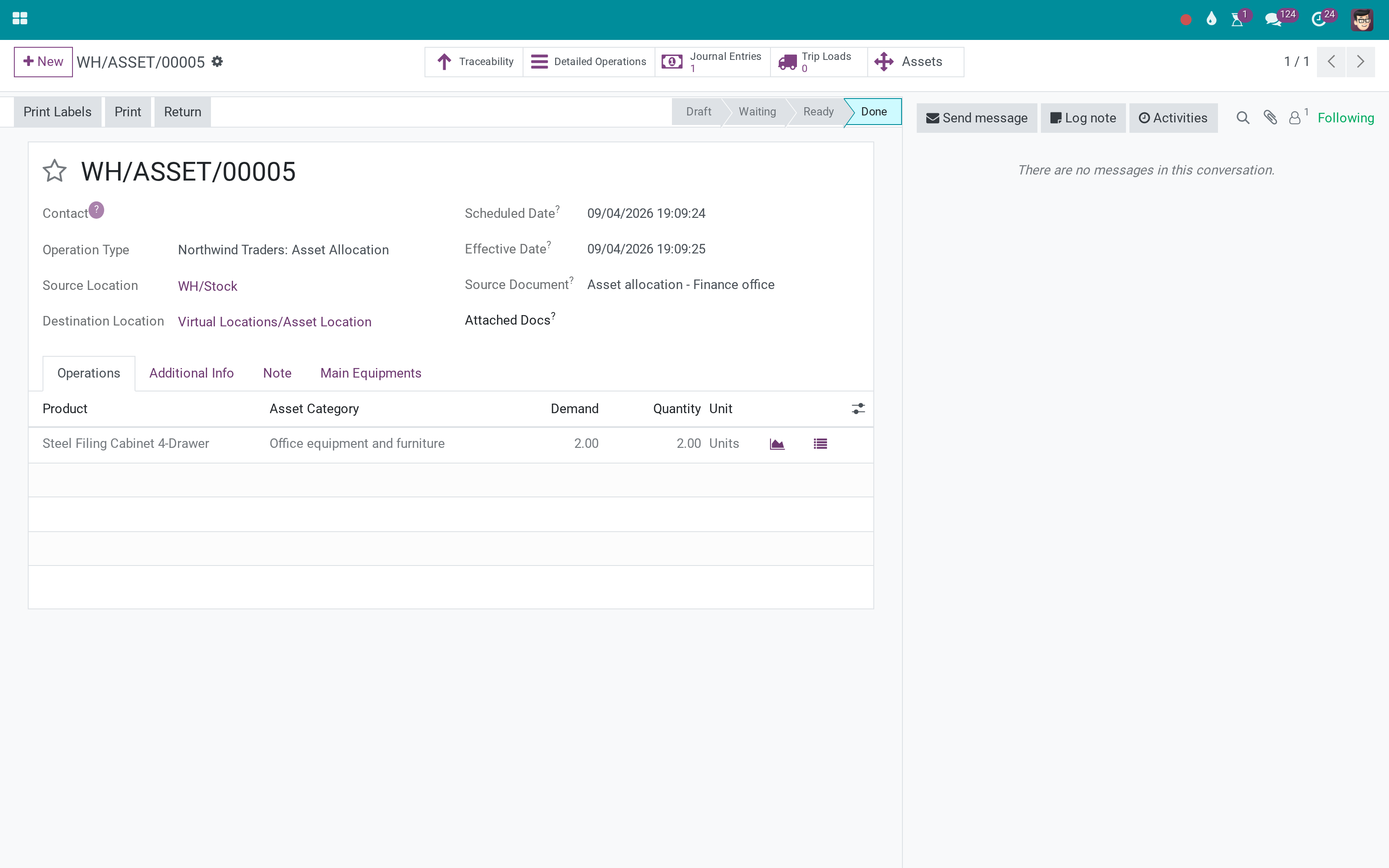
The allocation
Two filing cabinets from stock to the asset location, with an Assets button.
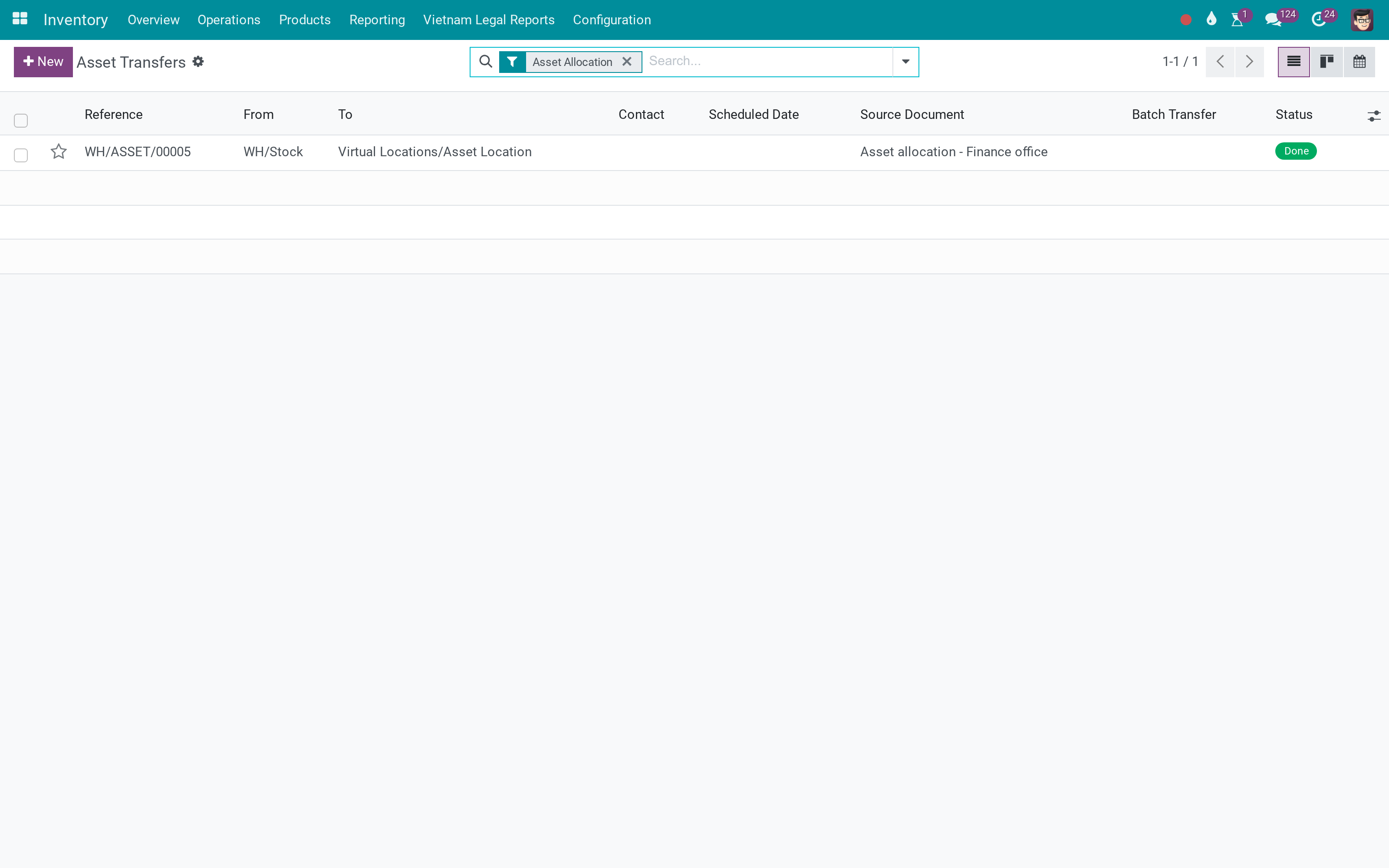
The transfers
All allocations in one list.
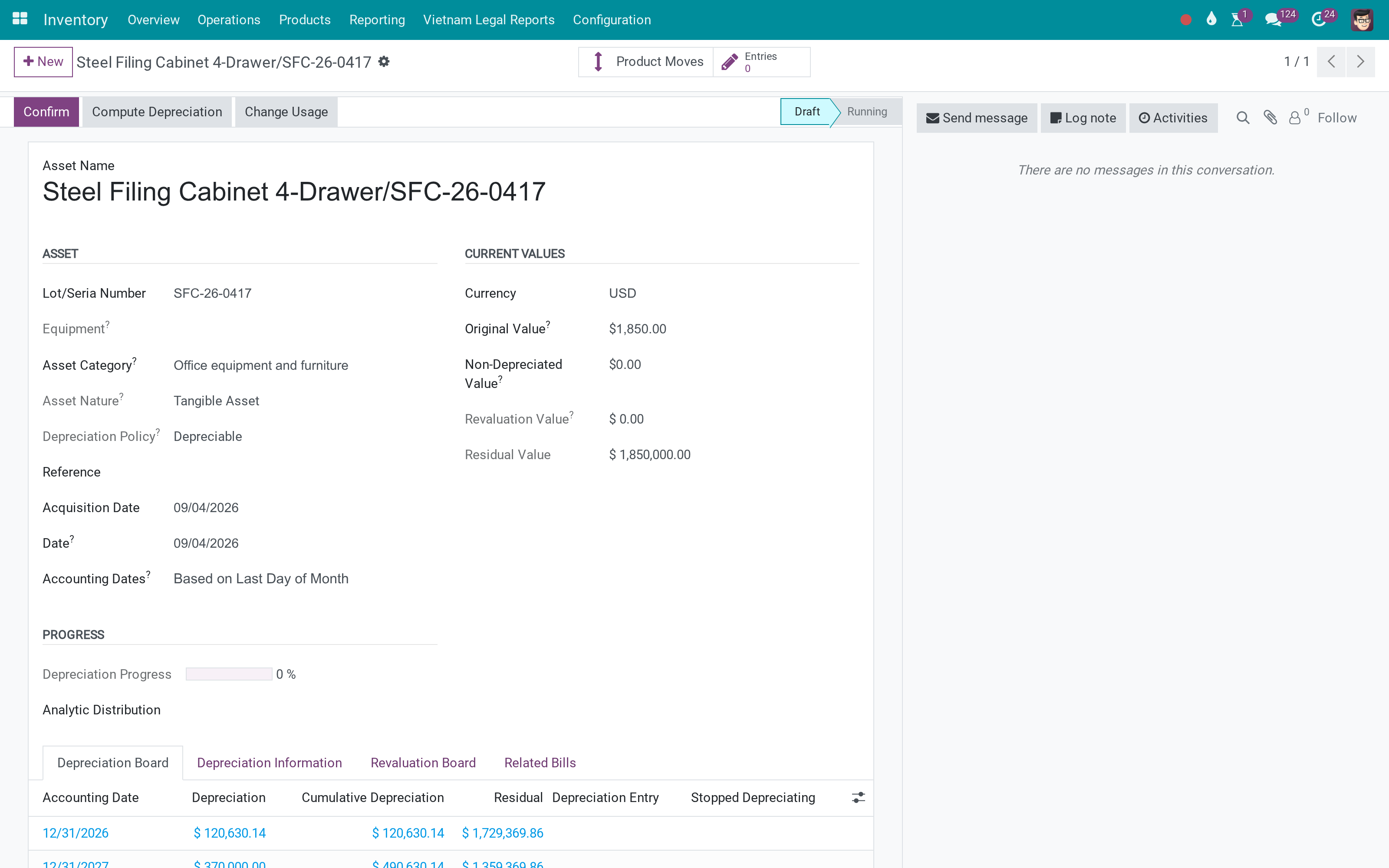
The asset
Named by product and serial, valued at stock cost, with a Stock In button.
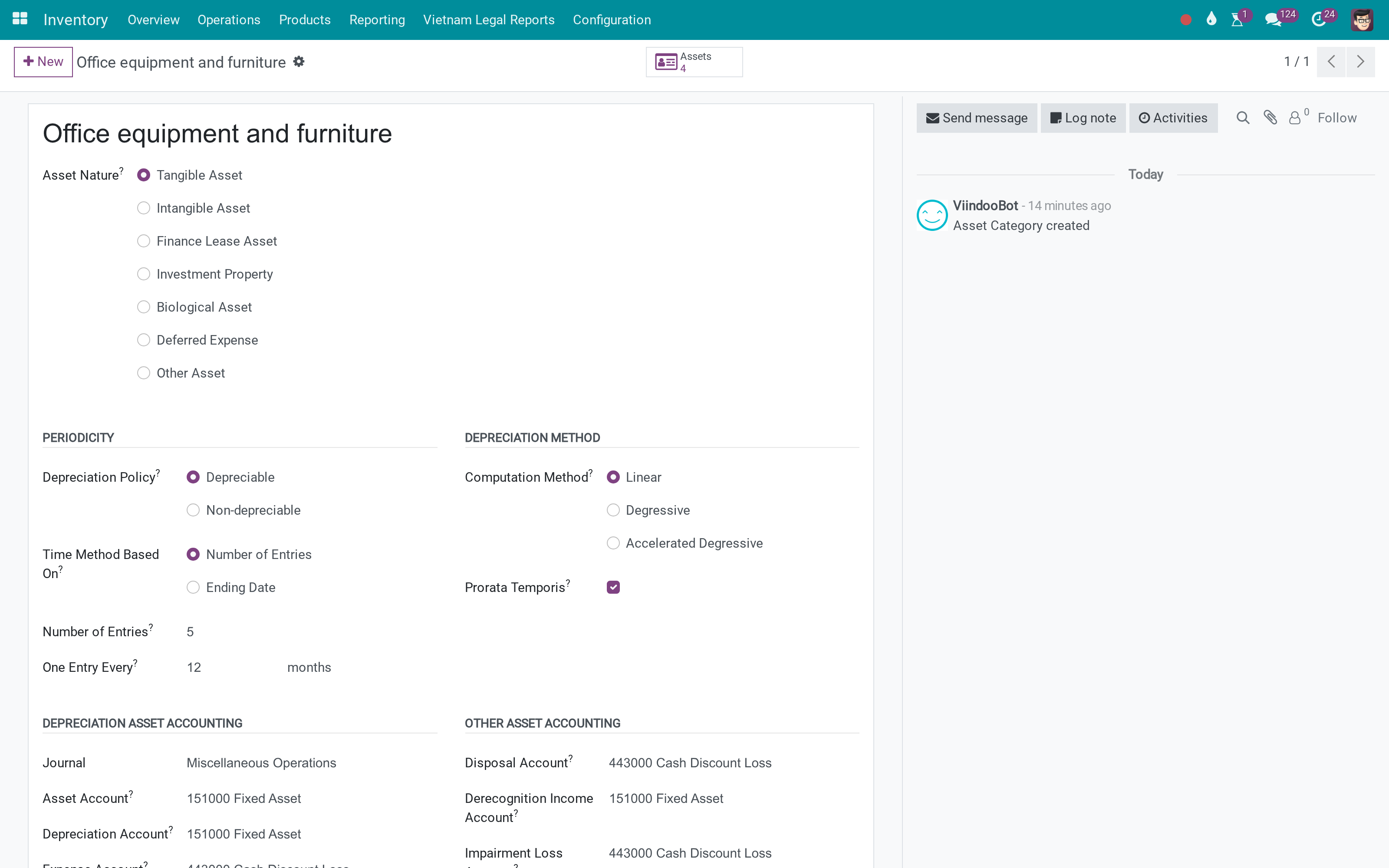
The category
The stock input account Stock In uses.
What You Get
Asset Allocation operation type and location usage
One asset per serial number or lot, at the stock value and product asset category
Journal entry from stock to the asset account
Stock In wizard on the asset, back to a chosen location
Return of an allocation: removes only the assets returned and credits the asset account
Move lines linked to the assets they created; Assets button on the transfer
Stock input account on the asset category
More Screens
Everything below was taken on a database seeded with real business data, on this series - not a mock-up and not a screenshot from an older version.
Asset category
What This App Does Not Do
Read this before you buy. Everything below is a rule of the app.
Untracked products are refused. A lot becomes one asset for its whole quantity.
Set it on the product first.
Dated when the transfer is validated. Confirm it to start depreciation.
Add more asset locations if you need them.
Done quantities and lots are locked. A lot returns only whole; a lot the transfer did not allocate is refused. Once an asset leaves Draft, the transfer cannot be returned; a user with the Accounting Assets Management right uses Stock In on the asset.
Each returned unit comes back into stock at the value its asset carries, landed costs added after the allocation included.
Works Well With
Apps from the same stack, built to fit this one:
Who Should Use Stock Asset?
Warehouse
Issues equipment to use with a normal transfer.
Fixed-asset accountant
Gets the asset created and valued.
Purchasing
Buys equipment as stock without deciding upfront.
Auditor
Follows the serial from receipt to asset.
Frequently Asked Questions
What does Stock Asset do?
An Asset Allocation operation that turns lot- or serial-tracked stock into assets - one asset per serial number or lot, at the stock value - plus Return and a Stock In wizard that bring units back to inventory.
What does Stock Asset not do?
It needs lot- or serial-tracked products with an asset category. A return credits the asset account at the value of the assets returned: see the rules above.
Who is Stock Asset for?
Warehouse: Issues equipment to use with a normal transfer. Fixed-asset accountant: Gets the asset created and valued. Purchasing: Buys equipment as stock without deciding upfront. Auditor: Follows the serial from receipt to asset.
Which Odoo version and editions does it support?
Odoo 19.0 - Odoo Community, Viindoo Cloud. Upgrades to a newer Odoo series are a separate purchase for that series.
What does it depend on?
It installs on top of: to_account_asset, stock_landed_costs, viin_stock_account, to_base. Odoo installs them with it.
How do I set it up?
Transfer serialised units to the asset location; confirm the assets it created.
What works well with it?
Assets Management (to_account_asset): The register. Equipment from stock (to_stock_equipment): Maintenance equipment from the same serial.
Can I try it before buying?
Yes - the Live Preview button at the top of this page opens the module's own screen on a working database.
How do I get support?
Write to apps.support@viindoo.com with your Odoo version and the technical name to_stock_asset; pre-sales questions go to sales@viindoo.com.
See Stock Asset in Action
or use the Live Preview button at the top of this page
Need help with Stock Asset?
For questions, implementation support or a custom feature, contact Viindoo.
Pre-Sales & Partnership
sales@viindoo.comUpgrades to a newer Odoo series are a separate purchase for that series.
All Viindoo apps: Viindoo Apps
Technical Requirement
Changes log
0.1.6 - Latest on the 19.0 line
- Short-circuit hot create/write/_post paths.
- More short-circuit to avoid redundant execution.
- Add menu picking asset transfers.
- Error compute.
Tích hợp Kế toán Tài sản với Kho vận: hướng dẫn sử dụng
Hướng dẫn này dành cho kế toán viên giữ sổ tài sản, nhân viên kho xác nhận phiếu kho và quản trị viên cài đặt mô-đun. Hướng dẫn giải thích cách một mặt hàng trong kho trở thành tài sản cố định khi được chuyển tới địa điểm tài sản, và cách đưa tài sản trở lại kho.
Cài đặt
- Truy cập Ứng dụng.
- Tìm từ khóa to_stock_asset.
- Ấn Cài đặt.
Cấp phát hàng trong kho thành tài sản
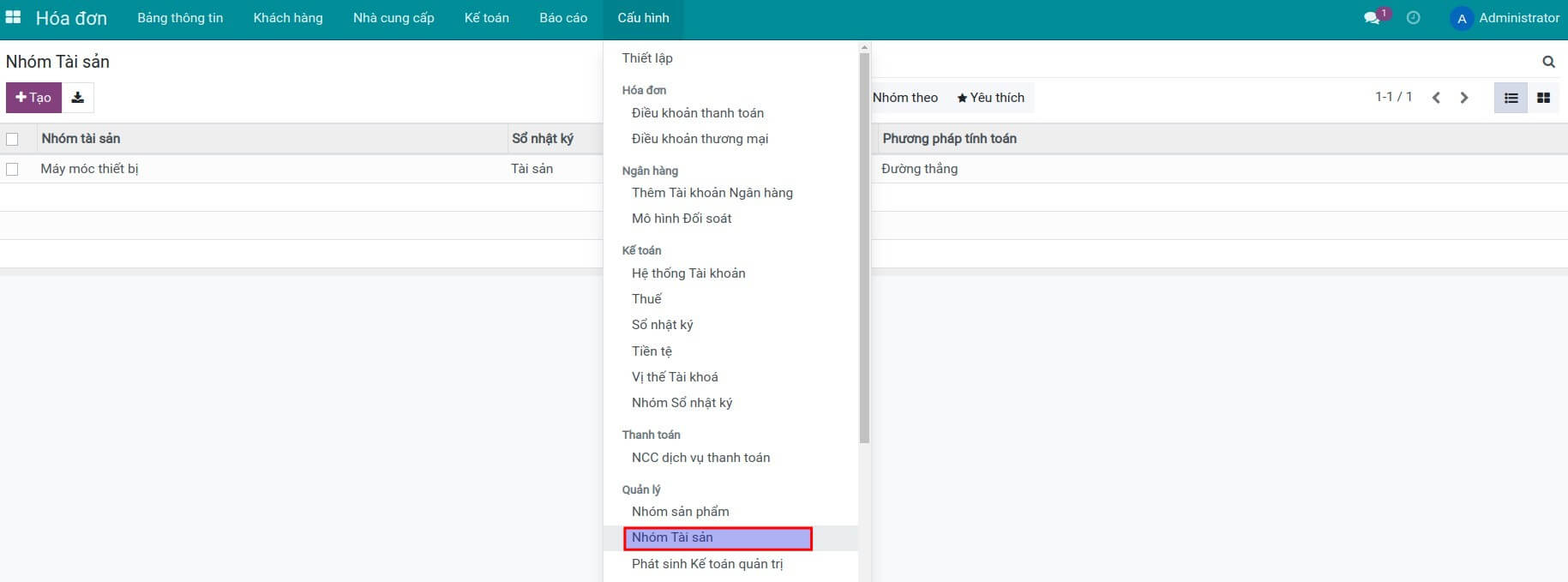
Bước 1: Tạo nhóm tài sản (Hóa đơn > Cấu hình > Quản lý > Nhóm tài sản).
Note
Để tạo nhóm tài sản, hãy bật tính năng Kế toán quản trị tại Hóa đơn > Cấu hình > Thiết lập.
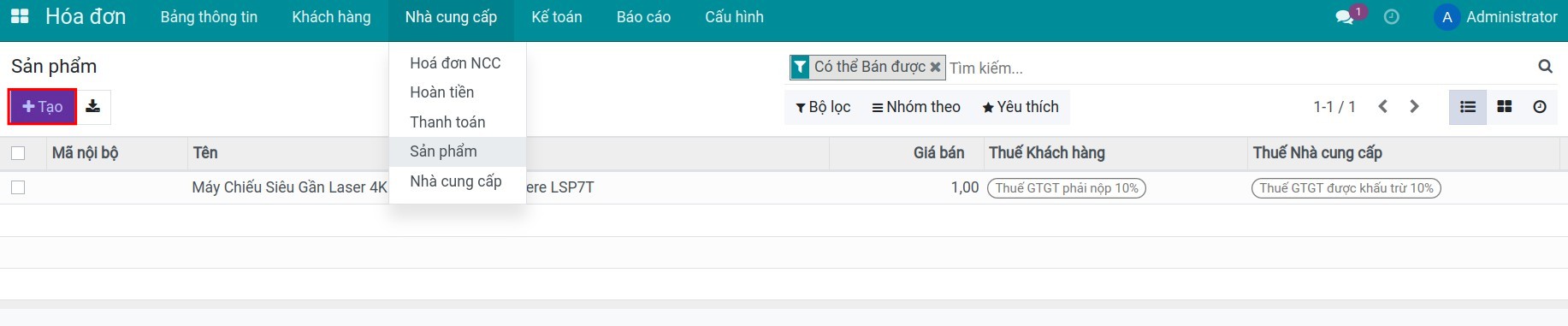
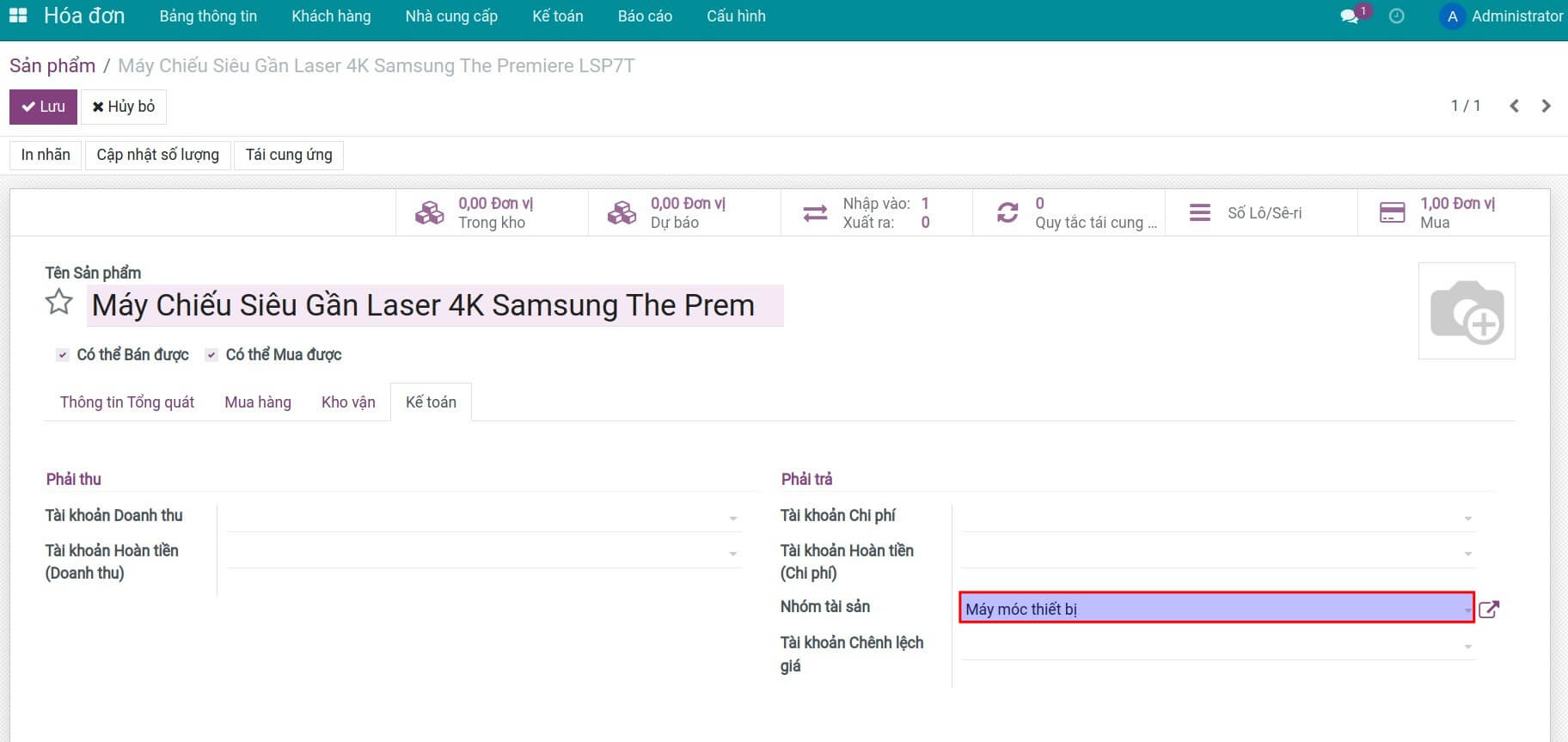
Bước 2: Tạo sản phẩm lưu kho được theo dõi theo số sê-ri hoặc lô, và chọn Nhóm tài sản cho sản phẩm.
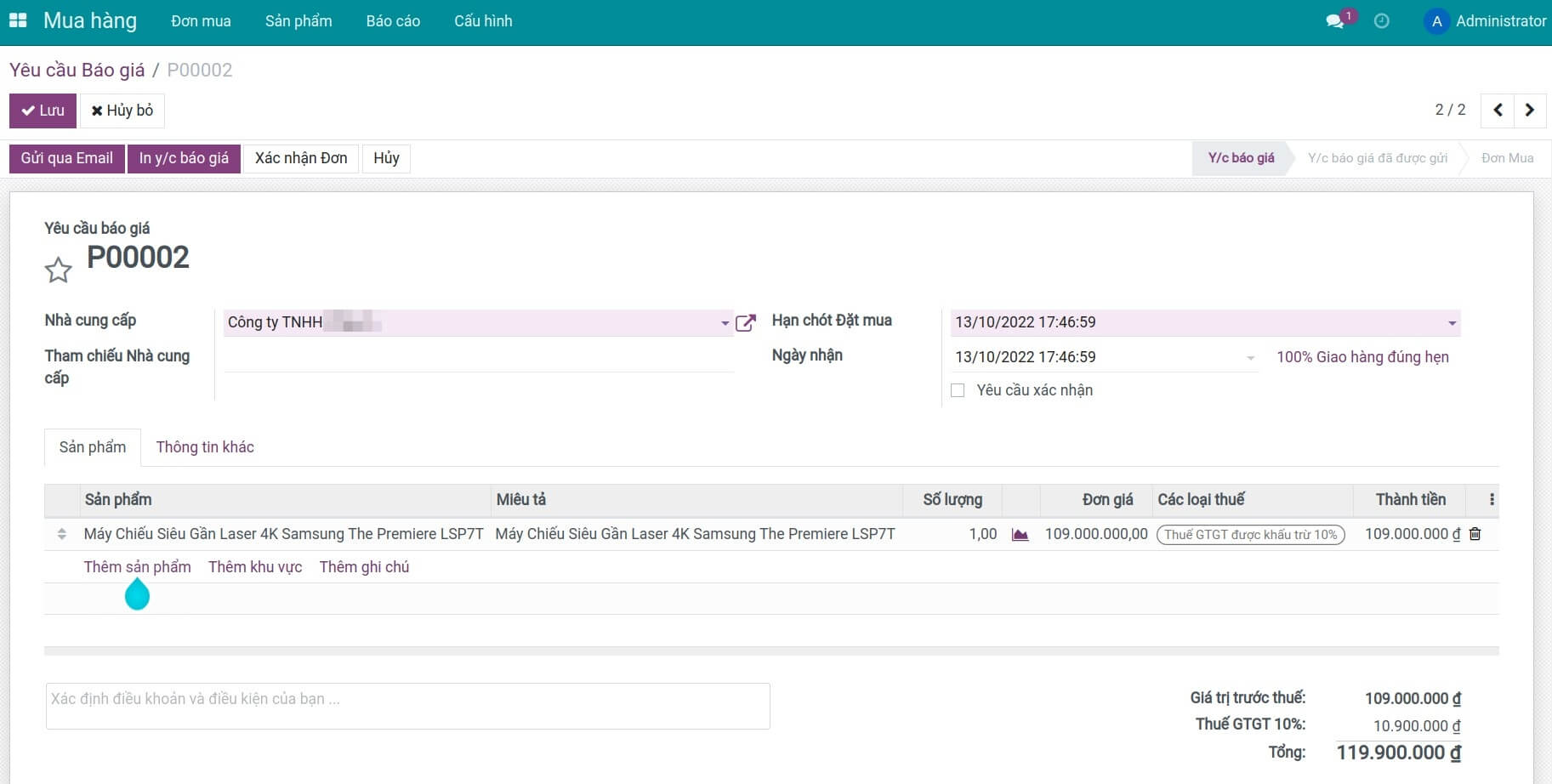
Bước 3: Tạo yêu cầu báo giá và xác nhận đơn mua.
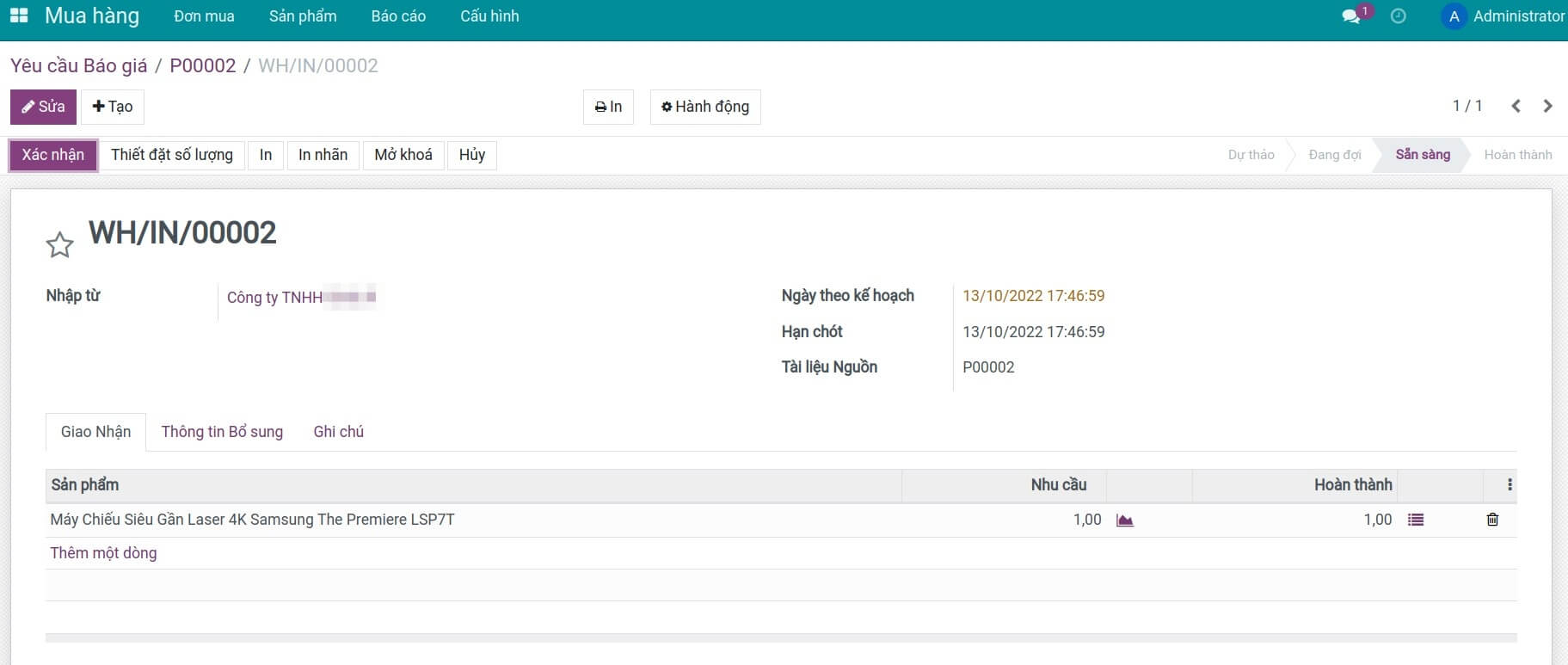
Bước 4: Nhận hàng về kho và nhập số sê-ri.
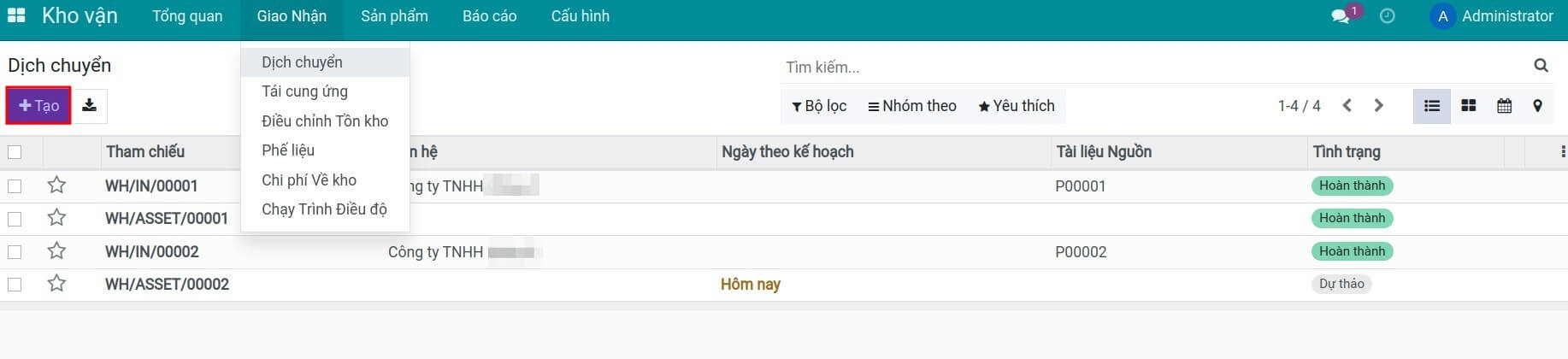
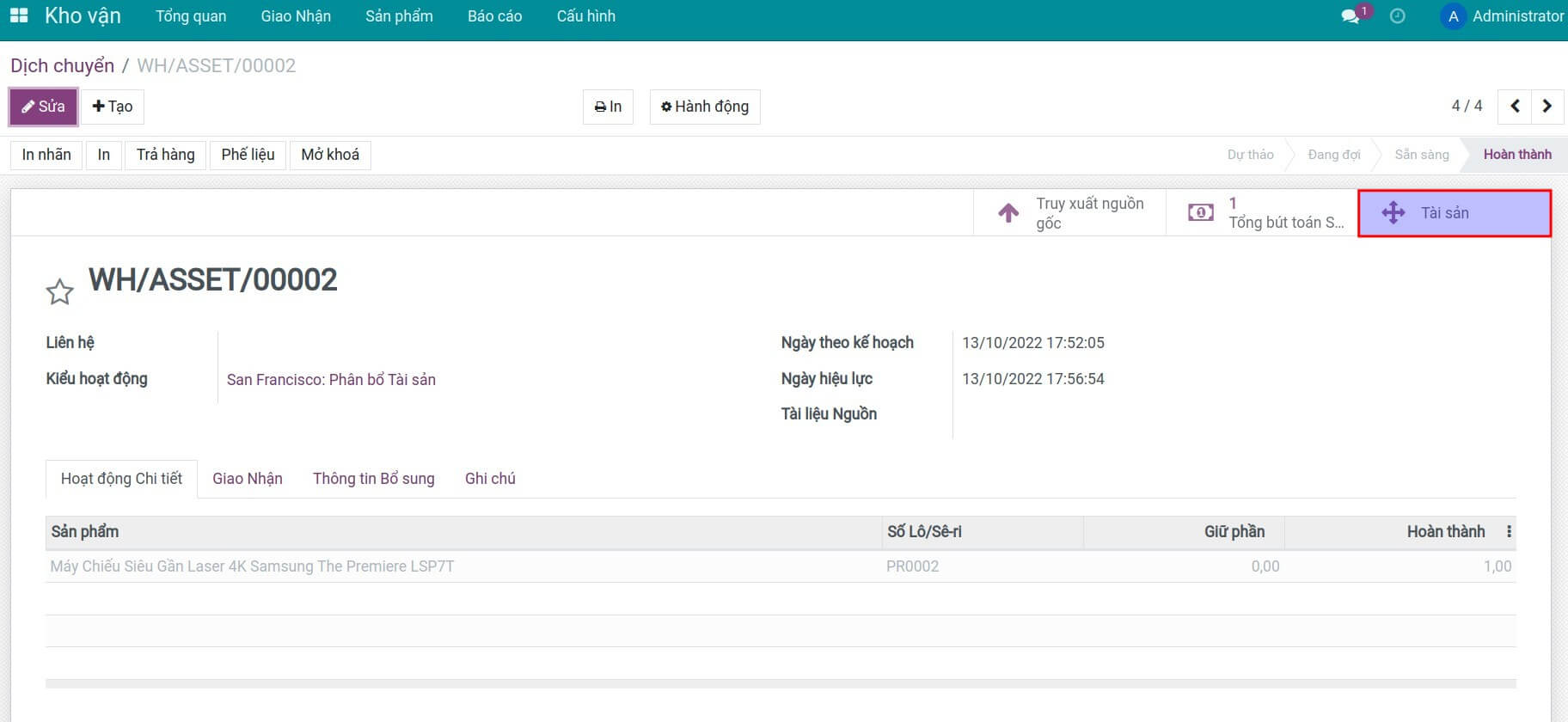
Bước 5: Vào Tồn kho > Nghiệp vụ > Phiếu kho, tạo phiếu có loại hoạt động Phân bổ tài sản rồi xác nhận. Mỗi số sê-ri hoặc lô trở thành một tài sản ở trạng thái Nháp.
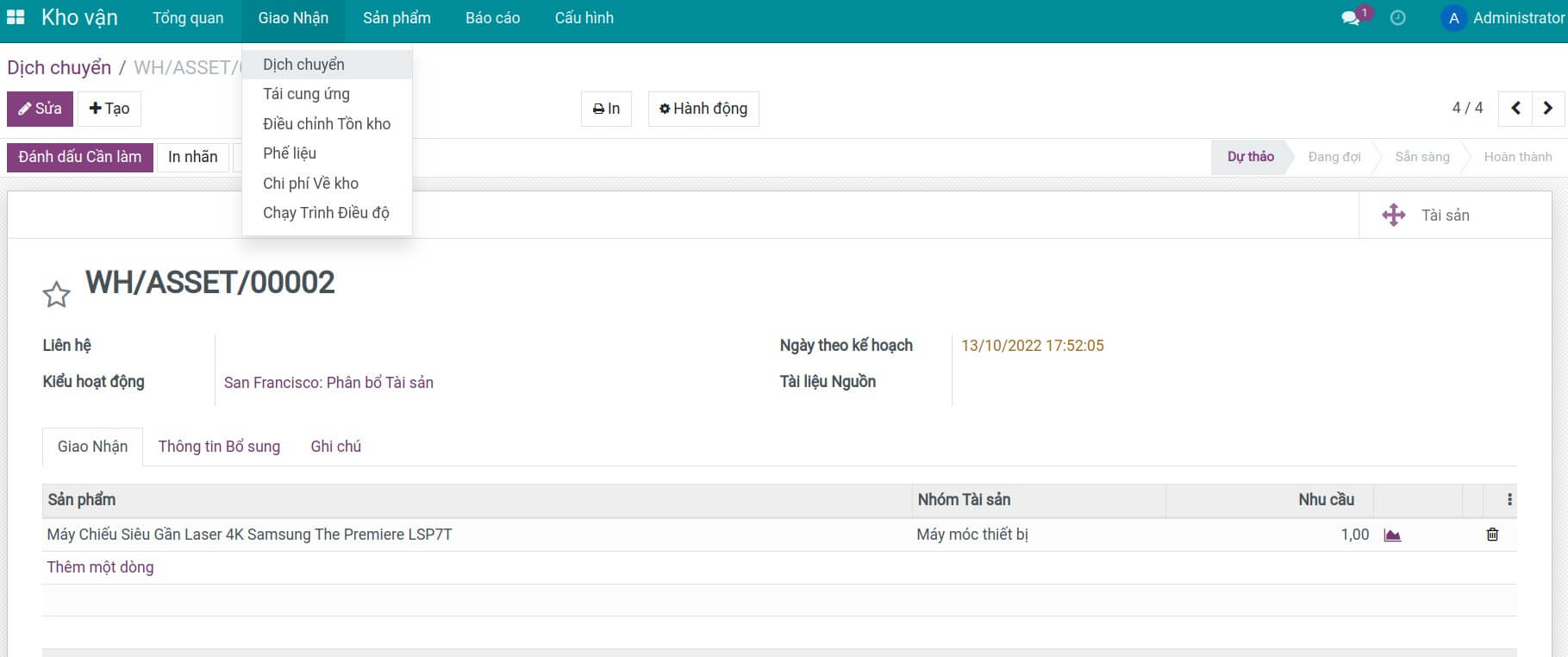
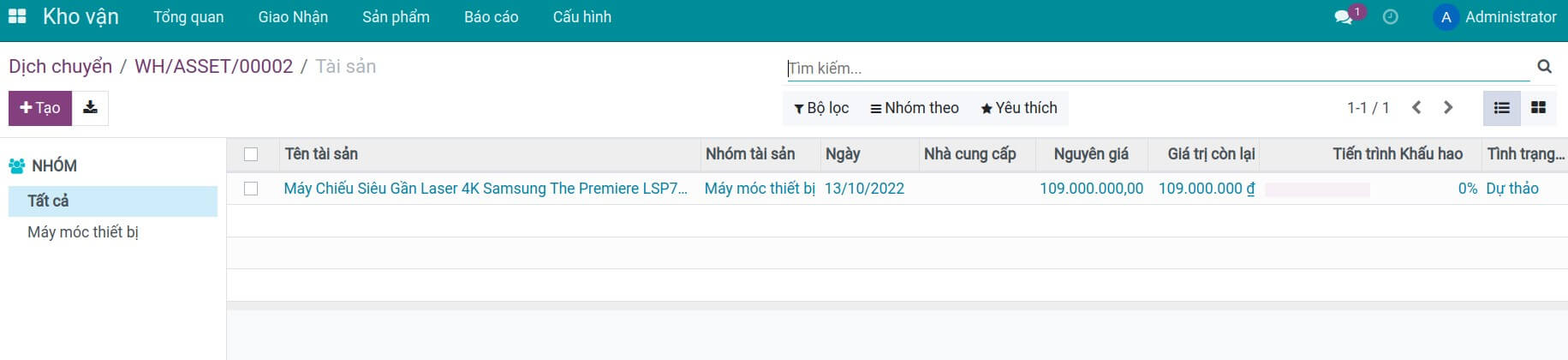
Bước 6: Bấm nút Tài sản trên phiếu để mở các tài sản phiếu đã sinh ra, hoặc vào Hóa đơn > Kế toán > Tài sản. Mỗi tài sản liên kết ngược tới lô và các dịch chuyển kho qua nút Dịch chuyển sản phẩm.
Ngày của tài sản được sinh ra
Tài sản sinh ra từ phiếu phân bổ tài sản mang ngày của dịch chuyển kho làm Ngày và làm ngày mua: là thời điểm phiếu được xác nhận. Khi nhóm tài sản để ngày ghi nhận đầu tiên theo cách thủ công, Ngày ghi nhận đầu tiên cũng nhận ngày đó.
Để nhập phiếu phân bổ vào một ngày trong quá khứ, xem mô-đun lùi ngày kho (viin_stock_backdate) và mô-đun cầu nối với mô-đun này, viin_stock_asset_backdate. Lùi ngày chỉ nhằm nhập dữ liệu quá khứ của doanh nghiệp trong giai đoạn triển khai ban đầu.
Thay đổi phiếu phân bổ sau khi xác nhận
Số lượng hoàn thành và các lô của phiếu phân bổ tài sản đã sinh tài sản không thể thay đổi. Muốn phân bổ thêm, hãy xác nhận một phiếu phân bổ tài sản mới. Muốn lấy lại hàng, dùng Trả hàng trên phiếu.
Trả hàng phiếu phân bổ tài sản
Mở phiếu đã xác nhận và bấm Trả hàng. Chỉ các tài sản của số hàng trả bị xóa, và tài khoản tài sản được ghi có.
- Một lô được phân bổ thành một tài sản chỉ được trả nguyên lô. Hãy trả toàn bộ lô, rồi phân bổ số hàng giữ lại bằng một phiếu phân bổ tài sản mới. Tài sản nháp mới mang ngày của phiếu mới; kế toán viên có thể sửa ngày đó khi tài sản còn ở trạng thái Nháp.
- Lô mà phiếu không phân bổ sẽ bị từ chối. Hãy trả lô đó từ phiếu phân bổ đã phân bổ nó.
- Phiếu có tài sản không còn ở trạng thái Nháp thì không thể trả hàng. Người dùng có quyền Quản lý Tài sản đưa các tài sản đang chạy hoặc đã đóng của phiếu về kho bằng nút Nhập kho trên tài sản.
- Một tài sản nháp trên phiếu có cả tài sản đang chạy được đưa về kho bằng cách xác nhận tài sản đó (Xác nhận, ghi nhận khấu hao đến thời điểm hiện tại), rồi Nhập kho.
Tài khoản tài sản được ghi có theo giá trị mà các tài sản được trả đang mang, và mỗi đơn vị trả về nhập lại kho theo giá trị tài sản của nó, kể cả chi phí mua hàng (landed cost) cộng vào sau khi phân bổ.
Tham khảo: Tài sản được tạo khi xuất dùng từ kho.
Phần mềm này và các tệp liên kết ("Phần mềm") được sử dụng (chạy, tuỳ biến, chạy sau khi được tuỳ biến) chỉ khi bạn mua được giấy phép có hiệu lực từ tác giả, điển hình như qua các Ứng dụng Odoo, hoặc trong trường hợp bạn nhận được thoả thuận bằng văn bản từ tác giả của Phần mềm (chi tiết tại tệp COPYRIGHT).
Bạn có thể phát triển các phân hệ Odoo có sử dụng Phần mềm như một Thư viện (thường là phụ thuộc vào, nhập vào và sử dụng nguồn của nó) nhưng không sao chéo bất kỳ mã nguồn hay tài liệu nào thuộc Phần mềm. Bạn có thể phân phối những phân hệ này theo giấy phép mà bạn lựa chọn, miễn sao nội dung giấy phép đó tương tích với điều khoản của Giấy phép Phần mềm Độc quyền Odoo (ví dụ: LGPL, MIT hay bất kỳ loại giấy phép phần mềm độc quyền nào tương tự vậy).
Nghiêm cấm phát hành, phân phối, cấp phép lại hoặc bán bản sao của Phần mềm hoặc bản sao Phần mềm đã được sửa đổi.
Thông báo bản quyền và chấp thuận nêu trên buộc phải được bao gồm trong tất cả các bản sao hoặc các phần quan trọng của Phần mềm.
PHẦN MỀM ĐƯỢC CUNG CẤP "NGUYÊN TRẠNG", KHÔNG BẢO ĐẢM DƯỚI BẤT KỲ HÌNH THỨC NÀO, ĐƯỢC THỂ HIỆN RÕ RÀNG HOẶC NGỤ Ý, KHÔNG GIỚI HẠN ĐẢM BẢO VỀ CÁC BẢO ĐẢM NGỤ Ý VỀ KHẢ NĂNG THƯƠNG MẠI, PHÙ HỢP VỚI MỤC ĐÍCH CỤ THỂ VÀ KHÔNG VI PHẠM. TRONG MỌI TRƯỜNG HỢP SẼ KHÔNG CÓ TÁC GIẢ HOẶC CHỦ SỞ HỮU BẢN QUYỀN NÀO CHỊU TRÁCH NHIỆM VỀ BẤT KỲ KHIẾU NẠI, THIỆT HẠI HOẶC TRÁCH NHIỆM PHÁP LÝ KHÁC NÀO TRONG PHẠM VI HỢP ĐỒNG, CÁC THIỆT HẠI HOẶC CÁCH KHÁC, PHÁT SINH TỪ, NGOÀI HOẶC CÓ LIÊN KẾT VỚI PHẦN MỀM HOẶC VIỆC SỬ DỤNG HOẶC KINH DOANH KHÁC TẠI PHẦN MỀM.