
Stock Account Backdate
| Lines of Code | 325 |
| Technical name | viin_stock_account_backdate |
| License | OPL-1 |
| Website | https://viindoo.com/apps/modules/19.0/viin_stock_account_backdate |
| Read description for | v 16.0 v 17.0 v 18.0 |
| Required Apps | Invoicing (account) Discuss (mail) Inventory (stock) |
| Included Dependencies | Inventory Backdate Backdate Operations |

Count entries booked in the period of the count
For companies on automated inventory valuation whose counts are entered after the count
Book the valuation entry of an inventory count in the accounting period of its counting date.
Odoo 19.0 · Odoo Community · Odoo Enterprise · OPL-1
Extends Inventory Backdate, which records the date a count actually took place. Installs by itself once Inventory Backdate and WMS Accounting are both installed.
What changes for your team
The accounting date follows the count
Today: a count typed in days later is applied with an empty Accounting Date, so its stock entry is booked on the day of entry.
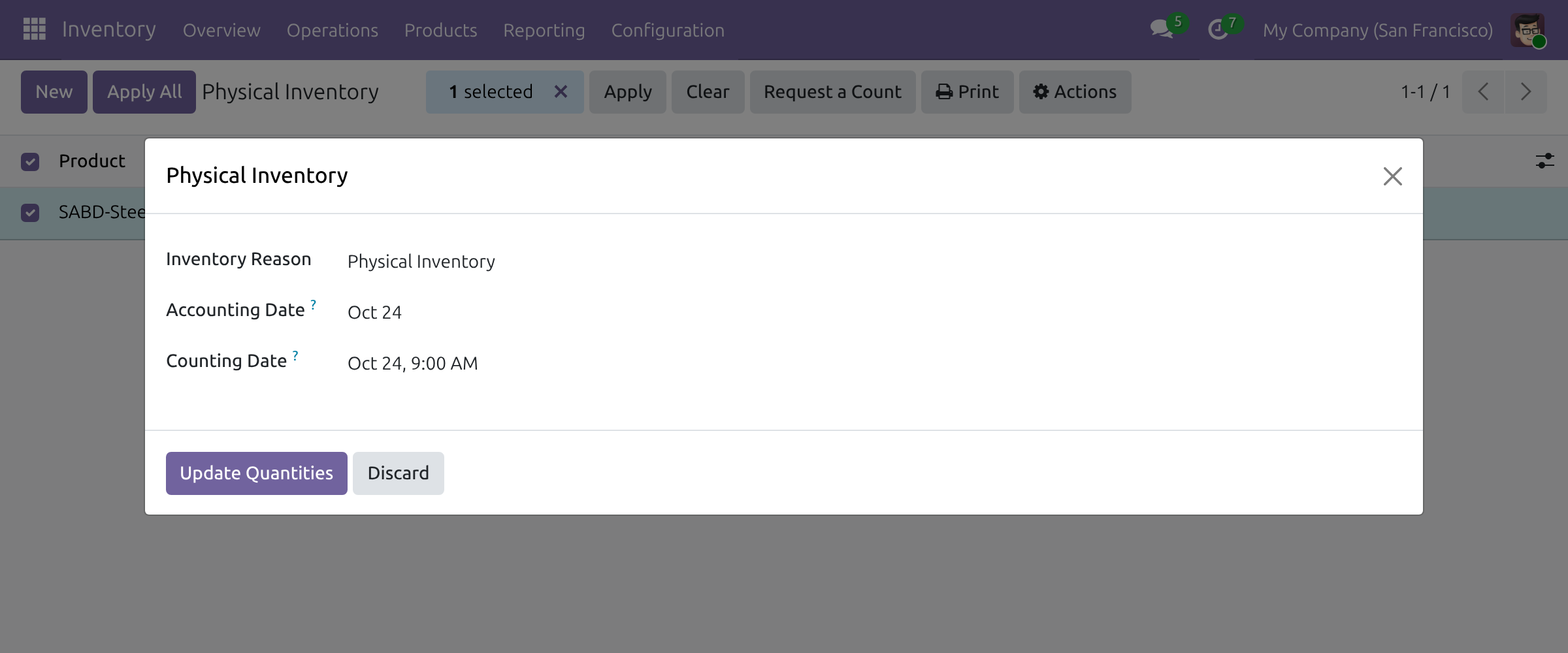
→ In Odoo's own Apply dialog, the Accounting Date proposes the day of the Counting Date, in the user's time zone. It can be changed to any day that is not in the future.
The accountant finds the entry in the right month
Today: last month's count turns up in this month's books and is corrected by hand at closing.
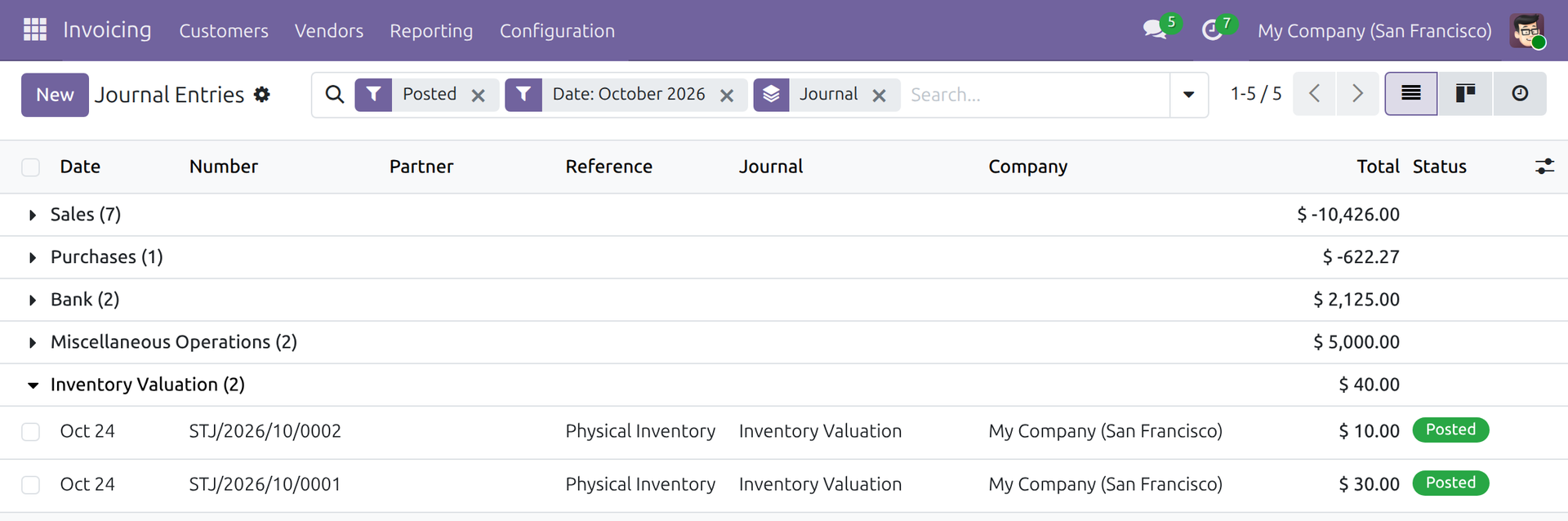
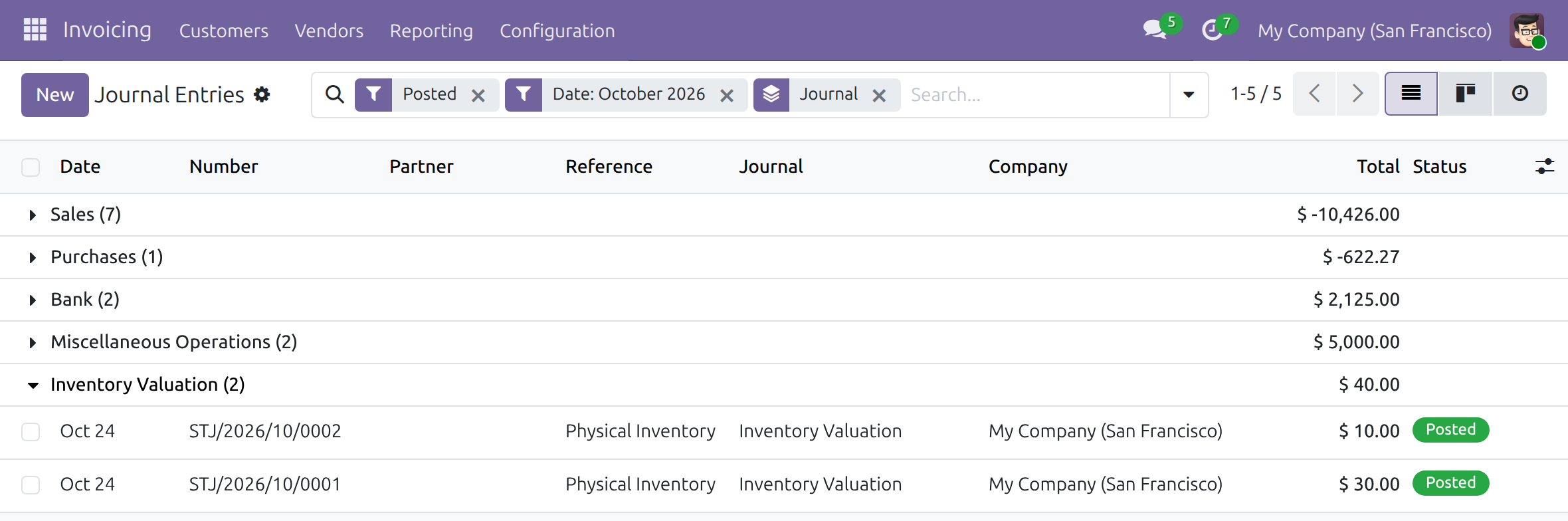
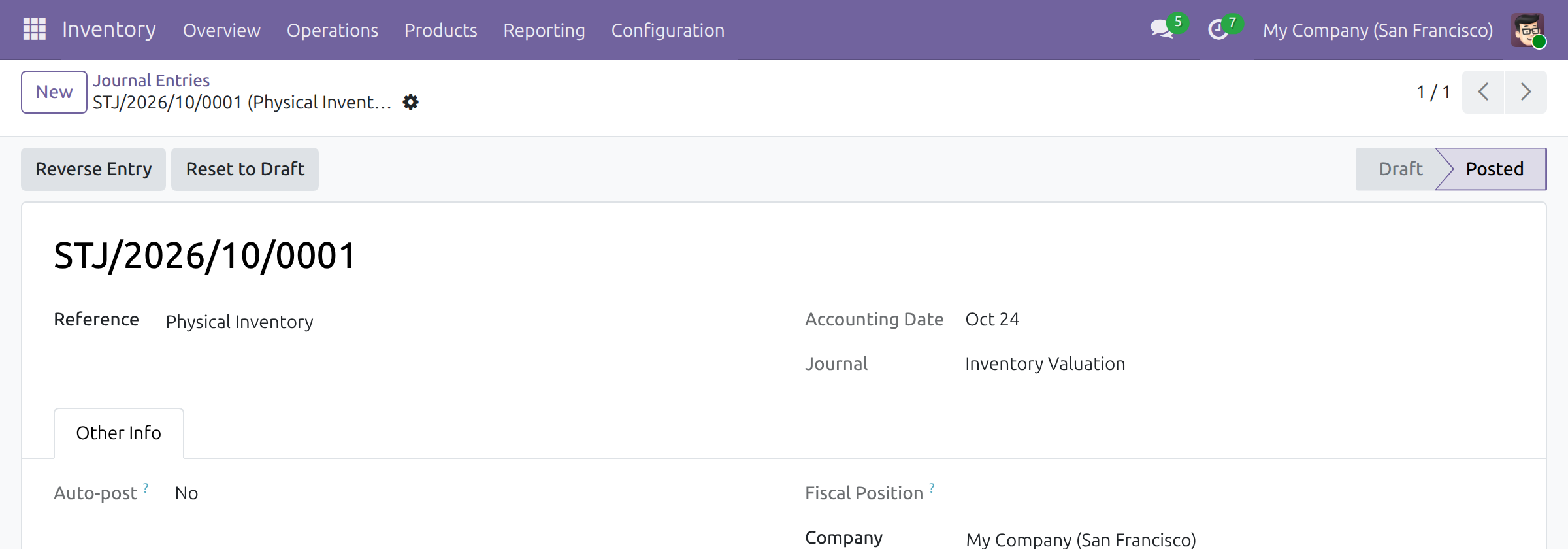
→ The entry of the Inventory Valuation journal carries the day of the count and is numbered in its month. With the Accounting Date cleared, it still lands on the day of the count.
No stock entry dated in the future
Today: a mistyped month or year in the Accounting Date dates the stock entry in a period that has not started.
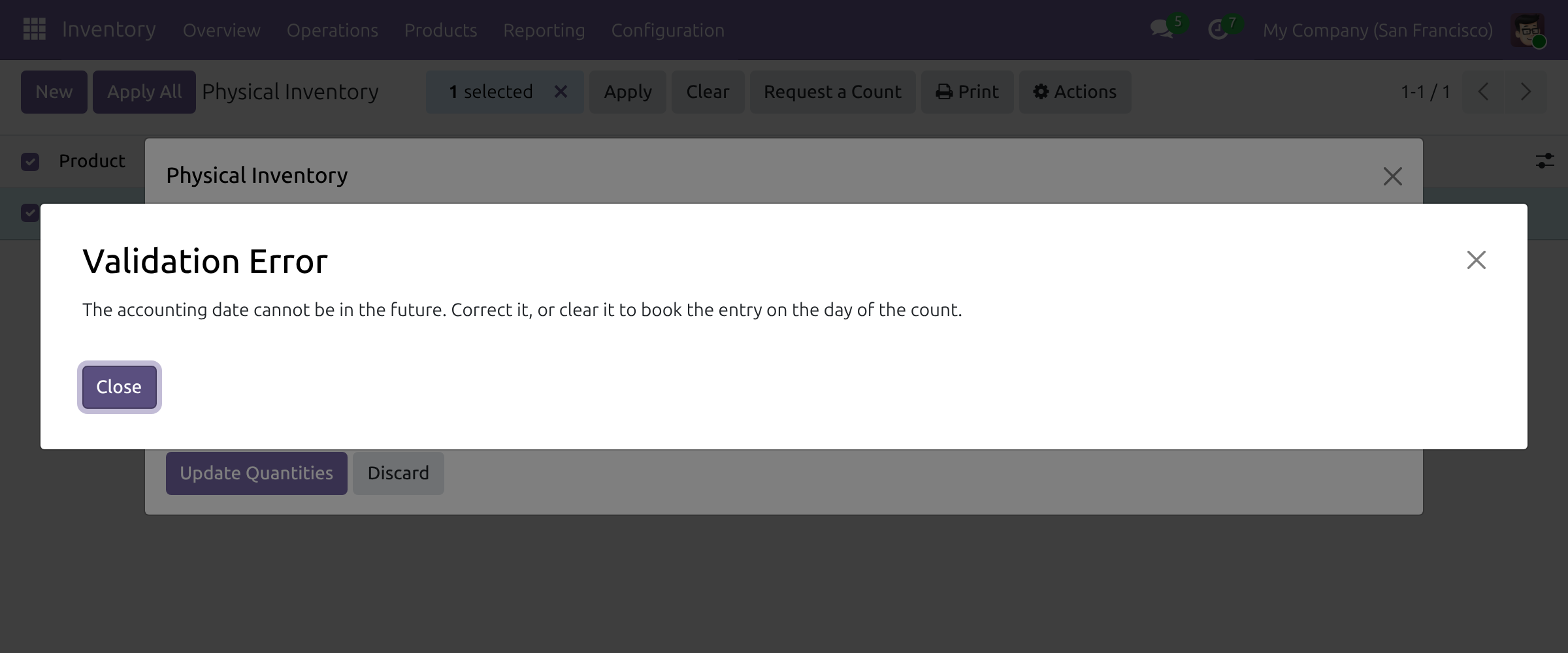
→ A future Accounting Date is refused with a message that says how to fix it. Nothing is applied and the counted quantities stay as entered.
Ready on day one
Nothing to switch on
No menu and no setting: the module works inside the Apply dialog of the Physical Inventory as soon as it is installed.
Check the valuation set-up
A count creates an entry for storable products whose category is valued Perpetual (at invoicing), when the Inventory adjustment location has a Loss Account.
What is included
The module dates the stock entries of inventory counts. With Inventory Backdate, a scrap validated on a past date gets its entry on the day of the scrap; manufacturing orders follow their date with Manufacturing Accounting Backdate. Receipts and deliveries create no stock entry of their own: they are valued through vendor bills and customer invoices.
Before you decide
Standard Odoo already has an Accounting Date in this dialog. What is different?
There it is empty by default, and an empty one books the entry on the day the count is applied. Here it proposes the day of the count, an empty one still books that day, and a future one is refused.
Does it get around a locked accounting period?
No. The count keeps its date and Odoo moves its journal entry out of the locked period, to today or to the last day of the first open month (31 December for journals numbered per year). A transfer dated in a locked period is refused.
How is a back-dated count valued?
At the cost in force when the count is recorded. The inventory value at a past date follows the movement dates.
Who can set the dates?
Any inventory user who applies a count; no extra right is needed. The Accounting Date appears when a counted product is valued automatically, and a counted line that carries its own accounting date keeps it.
Which languages and time zones does it handle?
It ships in English and Vietnamese. Each person enters dates in their own time zone, and the accounting day is the count's day in that time zone.
Try it, then ask us
The Documentation tab walks through checking the valuation set-up, applying a count on a past date and finding its entry.
Pre-sales & partnership
viindoo.com/contactusTechnical support
viindoo.com/ticketTechnical requirements
- Odoo version: 19.0
- Editions: Odoo Community, Odoo Enterprise
- Required modules: Inventory Backdate, WMS Accounting
- License: OPL-1
- Languages: English, Vietnamese
Stock Account Backdate
Note
This guide is for inventory managers who apply inventory counts, for accountants who check the stock journal entries, and for the administrator who sets the valuation up.
Note
Extends Inventory Backdate - see the Inventory Backdate documentation for back-dated counts, transfers and scraps.
Stock Account Backdate books the journal entry of a dated inventory count in the period of the count. A count made on Friday and entered on Monday is valued in the accounting period of Friday, never in the period in which somebody got to the keyboard, and never in the future.
Overview
Odoo stamps the valuation entry of a stock operation with the day it is entered. When a count is entered later than it was made, that entry falls into another accounting period than the stock movement it values.
The module installs by itself as soon as Inventory Backdate and the inventory valuation of Odoo are both installed. It adds no menu and no screen of its own: it completes the Apply dialog of Physical Inventory, which Odoo already offers.
- For products whose category is valued automatically, the dialog shows Accounting Date. It proposes the day of the Counting Date, in your own time zone.
- You can choose another Accounting Date that is not in the future.
- Left empty, the entry is still booked on the day of the count.
- An Accounting Date in the future is refused.
Who does what:
| Role | What they do | Access right to assign |
|---|---|---|
| Administrator | Ticks Inventory Backdate and checks the valuation set-up. | Role: Administrator |
| Inventory manager | Applies counts and sets the Counting Date and the Accounting Date. | Inventory: User (or Administrator) |
| Accountant | Checks that the stock journal entry carries the date of the count's period. | Accounting: Administrator |
Setup (for the Administrator)
Installation
- Open Settings ‣ Backdate Operations.
- In the Inventory block, tick Inventory Backdate and click Save.
Stock Account Backdate installs with it when the inventory valuation of Odoo is installed, and leaves with it when Inventory Backdate is removed.
Check the valuation set-up
A count creates a journal entry only when:
- the product is tracked in inventory and its category has Inventory Valuation set to Perpetual (at invoicing): see Inventory ‣ Configuration ‣ Products ‣ Categories;
- the location Inventory adjustment has a Loss Account: see Inventory ‣ Configuration ‣ Warehouse Management ‣ Locations.
If a count of an automatically valued product creates no entry, check the Loss Account first. Products in categories valued periodically create no entry at the count; their dialog shows the Counting Date only.
Inventory manager: apply a count on the day it was counted
For every inventory user. Any inventory user can set a past counting date; no extra right is needed.
Apply a count on a past date
- Open Inventory ‣ Operations ‣ Adjustments ‣ Physical Inventory.
- Enter the counted quantity of each line, tick the lines and click Apply (or Apply All).
- In the dialog Physical Inventory, set Counting Date to the date and time of the count.
- Check the Accounting Date: it shows the day of the count. Change it if the entry must be booked on another day, never in the future.
- Click Update Quantities.
The movement of the count carries the counting date, and its valuation entry is booked on the Accounting Date. Clear the Accounting Date and the entry is booked on the day of the count.
An Accounting Date in the future is refused
A later Accounting Date than today is refused with "The accounting date cannot be in the future. Correct it, or clear it to book the entry on the day of the count.". Nothing is applied and the counted quantities stay as you entered them: click Close, correct the date or clear it in the open dialog and click Update Quantities again.
The Apply button at the end of a line applies that line at the current time, without a dialog. Select the line and use Apply at the top of the list to choose the dates.
Accountant: check the entry of a count
Find the entry of a count
- Open Journal Entries in the accounting menu, under Transactions.
- Open the entry of the stock journal Inventory Valuation. Its reference is the reason given in the dialog, by default "Physical Inventory".
- Check the Accounting Date: it is the day of the count, or the date chosen in the dialog.
The entry is numbered from the month of its accounting date, so it sits in the period of the count.
Good to know
- Only movements to or from a location with a valuation account create a journal entry, such as inventory counts and scraps. Receipts and deliveries are valued through vendor bills and customer invoices.
- Scraps validated on a past date and manufacturing orders follow the date chosen for them: see the guides of Inventory Backdate and Manufacturing Accounting Backdate.
- A back-dated count is valued at the cost in force when it is recorded. The inventory value at a past date follows the dates of the stock movements.
- An accounting date inside a locked period does not stop a count. The movement keeps its date and Odoo moves the journal entry to today, or to the last day of the first open month (31 December for journals numbered per year). A transfer dated in a locked period is refused.
- Dates are entered in your time zone: the accounting day is the day of the chosen date in your own time zone.
- Outgoing movements already valued are not valued again when an earlier receipt is recorded afterwards; the closing entries adjust the stock value.
This software and associated files (the "Software") may only be used (executed, modified, executed after modifications) if you have purchased a valid license from the authors, typically via Odoo Apps, or if you have received a written agreement from the authors of the Software (see the COPYRIGHT file).
You may develop Odoo modules that use the Software as a library (typically by depending on it, importing it and using its resources), but without copying any source code or material from the Software. You may distribute those modules under the license of your choice, provided that this license is compatible with the terms of the Odoo Proprietary License (For example: LGPL, MIT, or proprietary licenses similar to this one).
It is forbidden to publish, distribute, sublicense, or sell copies of the Software or modified copies of the Software.
The above copyright notice and this permission notice must be included in all copies or substantial portions of the Software.
THE SOFTWARE IS PROVIDED "AS IS", WITHOUT WARRANTY OF ANY KIND, EXPRESS OR IMPLIED, INCLUDING BUT NOT LIMITED TO THE WARRANTIES OF MERCHANTABILITY, FITNESS FOR A PARTICULAR PURPOSE AND NONINFRINGEMENT. IN NO EVENT SHALL THE AUTHORS OR COPYRIGHT HOLDERS BE LIABLE FOR ANY CLAIM, DAMAGES OR OTHER LIABILITY, WHETHER IN AN ACTION OF CONTRACT, TORT OR OTHERWISE, ARISING FROM, OUT OF OR IN CONNECTION WITH THE SOFTWARE OR THE USE OR OTHER DEALINGS IN THE SOFTWARE.